
Pirate Ship Ranks: Crew Hierarchy, Roles & Duties
Pirate ship ranks covered a mix of leadership positions, skilled trades, and ordinary sailing duties. The captain and quartermaster usually held the greatest authority, while specialists such as the sailing master, boatswain, gunner, carpenter, and surgeon kept the ship navigable, armed, repaired, and supplied.
This guide explains who did what aboard a pirate ship, how much authority each position could carry, and what surviving prize-share agreements reveal about the way pirate crews were organized.
Roles and Positions on a Pirate Ship
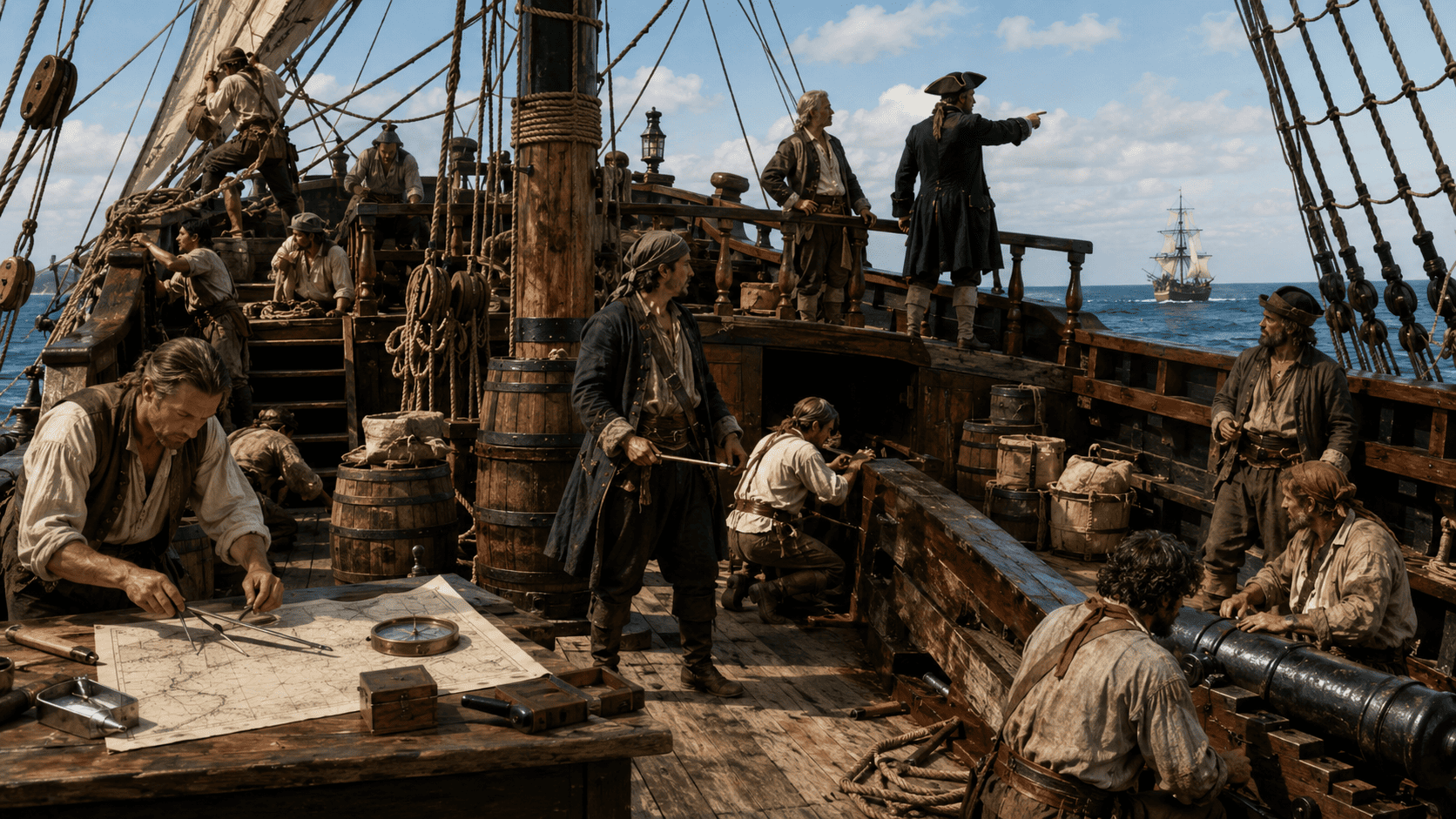
Pirate crews had a recognizable hierarchy, but it was not the same as the formal rank structure of a navy. Positions were tied mainly to leadership, practical expertise, and the needs of the vessel. The captain and quartermaster usually stood at the top of the crew's power structure, while other officers and specialists exercised authority within their areas of responsibility.
Pirate Crew Hierarchy at a Glance
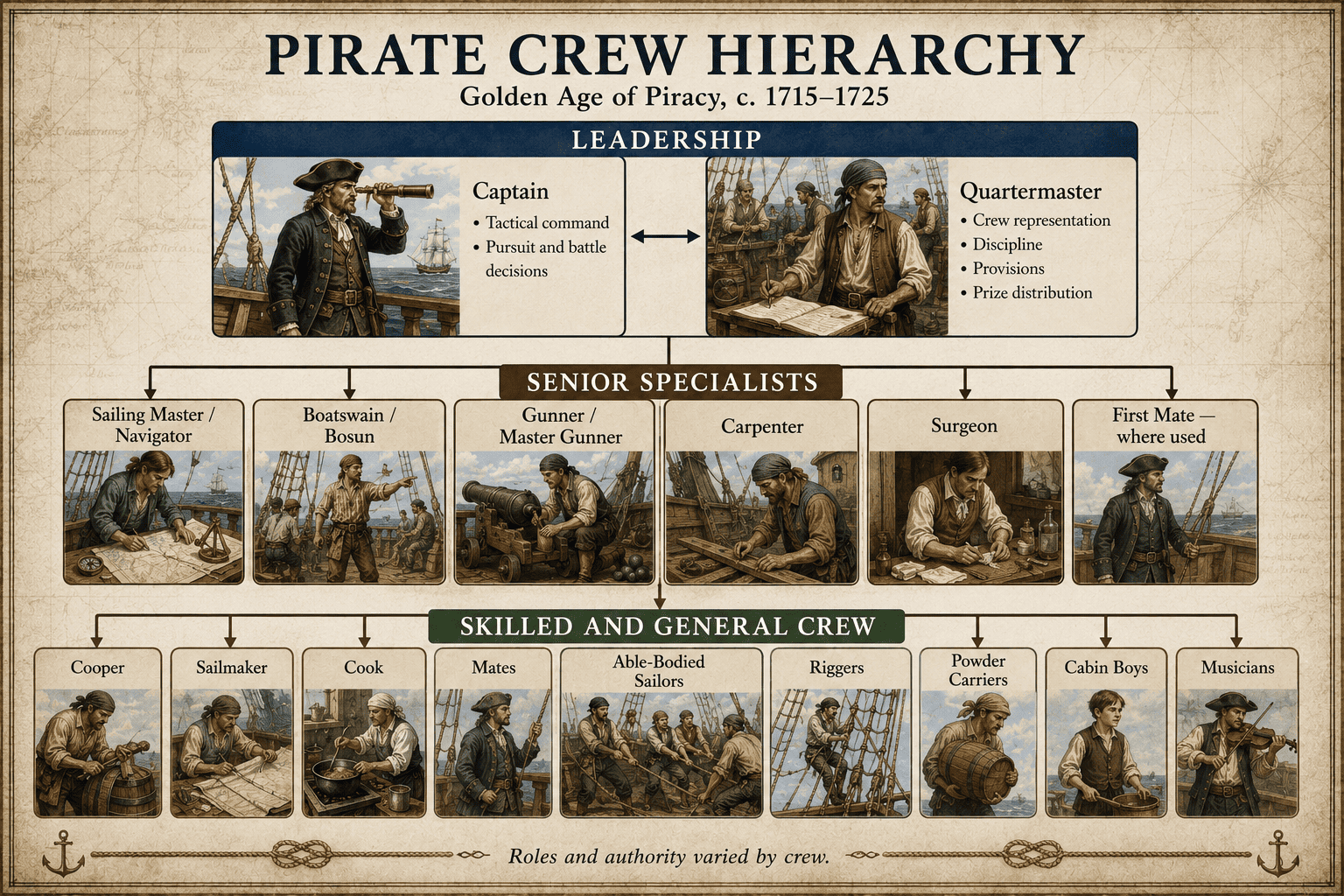
A typical pirate crew could include the following positions, although the exact arrangement differed from ship to ship:
| Rank or Role | Main Responsibility | Approximate Authority |
|---|---|---|
| Captain | Led the ship in battle, pursuit, and major tactical situations | Very high, especially during combat |
| Quartermaster | Represented the crew, enforced rules, managed provisions, and helped divide prizes | Very high |
| First Mate | Assisted senior leadership where the position existed | High, but varied by crew |
| Sailing Master / Navigator | Planned courses and handled navigation | Senior specialist |
| Boatswain / Bosun | Supervised deck work, rigging, sails, and ship maintenance | Senior specialist |
| Gunner / Master Gunner | Managed cannons, ammunition, and gun crews | Senior specialist |
| Surgeon | Treated injuries and illnesses when a trained medical professional was available | Specialist |
| Carpenter | Repaired the hull, masts, and structural damage | Specialist |
| Cooper | Built and repaired barrels and casks | Skilled crew member |
| Sailmaker | Repaired and maintained sails | Skilled crew member |
| Cook | Prepared and managed food provisions | Crew specialist |
| Ordinary Seamen | Performed sailing, maintenance, watch, and combat duties | General crew |
A specialist did not need political authority to be indispensable. A navigator who could find a safe course or a carpenter who could stop a serious leak might be as important to survival as any senior officer. The same was true of the gunner during an engagement or the boatswain when the crew needed to handle sails, anchors, and rigging efficiently.
Were Pirate Ship Roles Formal Ranks?
Usually not. Terms such as captain, quartermaster, boatswain, and sailing master described recognized positions, but pirate crews did not follow one universal rank system. Their shipboard articles could define rules, discipline, compensation, and the division of prizes, while the exact powers attached to individual roles varied between crews.
It is therefore more accurate to use pirate ship ranks as a convenient description of positions and levels of responsibility rather than as a fixed military chain of command.
Captain
The captain was the crew's principal tactical leader. He was expected to understand seamanship, recognize worthwhile targets, judge risk, and make fast decisions during a chase or battle. A capable captain also had to read the intentions of another vessel, decide whether a target was worth pursuing, and avoid fights that offered little reward for too much danger.
Success mattered because captured ships and cargo were the economic basis of piracy. Courage alone was not enough; the crew needed a leader who could combine aggression with judgment. Repeatedly losing prizes, choosing poor targets, or exposing the vessel to unnecessary danger could quickly weaken confidence in his leadership.
How Was a Pirate Captain Chosen?
Pirate captains were often selected by the crew. Experience as a sailor, privateer, navigator, merchant officer, or proven pirate could strengthen a candidate's claim, but the essential requirement was trust in his ability to lead. The office was therefore based more on demonstrated competence and support from the company than on appointment by a government or advancement through a permanent naval career.
The position could also be taken away. In November 1718, Charles Vane's crew removed him after a dispute over whether to attack a vessel and chose John Rackham, better known as Calico Jack, as captain instead. The episode shows that a pirate captain's authority ultimately depended on continued support from the men aboard.
When Did the Captain Have Absolute Authority?
The captain's power was strongest during combat, pursuit, escape, and other urgent tactical situations. In those moments, debate could put the ship at risk, so one person needed to direct maneuvering and the response to a changing enemy.
Outside battle, his power could be more limited. Shipboard articles and other senior figures, especially the quartermaster, could shape discipline, supplies, captured goods, and crew interests. The captain was therefore the leading battlefield commander, not necessarily an unchecked ruler in everyday shipboard life.
First Mate
A first mate could assist with watchkeeping, navigation, discipline, and the general operation of the vessel. On some ships, he might also take command when the captain was unavailable. The title was familiar from merchant and naval practice, but pirate crews did not apply it consistently.
Was the First Mate a Standard Pirate Rank?
No. Some pirate crews used the title, while others relied on a quartermaster, sailing master, or experienced mate to handle similar responsibilities. It is misleading to assume that every crew followed a fixed sequence of captain, first mate, and quartermaster.
Where the position existed, its importance depended on the organization of that particular ship. The mate might be valued for seamanship and the ability to supervise men without automatically becoming the crew's main political second-in-command. In many pirate companies, the quartermaster exercised greater influence over discipline, provisions, crew representation, and captured goods.
Quartermaster
The quartermaster was one of the most influential figures aboard many pirate ships and could act as a counterweight to the captain. He represented crew interests in day-to-day matters, helped enforce agreed rules, and could oversee provisions and captured property. On some vessels he also stepped into leadership when the captain was absent, although his exact duties depended on the crew.
Authority, Discipline, and Crew Representation
The quartermaster often helped enforce the ship's articles, which could regulate conduct, punishment, injury compensation, and other terms agreed by the crew. He might deal with disputes, supervise penalties for violations such as theft or fighting, and make sure supplies were handled according to the crew's rules.
Managing provisions was a practical source of influence. Food, water, weapons, and other stores had to be rationed and protected during long cruises. A quartermaster who handled those resources poorly could create problems for the entire company, while fair distribution reinforced the trust on which the office depended.
This made him more than an assistant to the captain. His authority was closely connected to the crew's trust and to the practical need to maintain order among armed men living and working in confined conditions.
Loot Distribution and Prize Shares
After a captured vessel was secured, money, cargo, weapons, provisions, and other valuables had to be accounted for and divided. The quartermaster could play a central role in that process, applying the shares established by the crew's articles. Valuable items could not simply be claimed by whoever found them first without risking conflict.
Senior leaders and skilled officers sometimes received larger portions than ordinary sailors, but the distribution differed between crews. Fair accounting mattered because prize money was one of the main reasons men joined and remained with a pirate company.
Sailing Master
The sailing master was the ship's principal navigation specialist. His knowledge helped the crew find shipping routes, approach ports, avoid shoals and reefs, and choose courses that supported pursuit or escape. He needed practical familiarity with coastal waters, prevailing winds, currents, tides, and known hazards, especially in areas where charts were incomplete.
Navigation, Charts, and the Navigator's Role
The sailing master, or navigator, used the tools and methods available during the seventeenth and early eighteenth centuries. These could include a magnetic compass, lead line, log line, nautical charts, and instruments for estimating latitude from celestial observations.
Charts were less complete and accurate than modern nautical maps, so a navigator could not depend on charted information alone. Detailed knowledge of coastlines, anchorages, reefs, currents, tides, and prevailing winds could be just as important. Navigators combined instruments with observation, written sailing directions, previous experience, and information learned from other mariners.
Latitude could be estimated with reasonable accuracy, but longitude remained difficult to determine at sea during the Golden Age of Piracy. Practical marine chronometers came later in the eighteenth century, so navigators often estimated position from their previous location, heading, speed, and elapsed time. A serious error could leave a ship off course, grounded, or unable to reach the merchant traffic it hoped to intercept.
Gunner
The gunner was responsible for the ship's artillery and the equipment that kept its cannons ready for action. Cannons required regular inspection, ammunition had to remain available, and gunpowder had to be protected from moisture and accidental ignition. The job combined technical knowledge with the ability to organize men under dangerous conditions.
Different types of shot served different purposes. Round shot could damage a hull, chain or bar shot could attack rigging and masts, and grapeshot or similar ammunition could be used against men at close range. Pirates often wanted to capture a vessel and its cargo rather than sink it, so destructive force had to be used with that objective in mind.
The Master Gunner and Cannon Crews
The most experienced artillery specialist could be known as the master gunner. He supervised the guns, checked their condition, organized ammunition, and directed the men assigned to cannon crews.
Firing a shipboard cannon required coordination. The crew loaded the powder and projectile, positioned and aimed the gun, fired it, controlled the recoil, swabbed the barrel, and prepared it for the next shot. Those steps had to be repeated quickly without allowing sparks or burning material near exposed powder.
Accuracy at sea was difficult because both the firing ship and its target were moving while waves continually changed the angle of the deck. Effective gunnery therefore depended heavily on timing, range, sea conditions, and experience rather than precise aiming alone.
Between engagements, the gunner also had to keep cannon barrels, carriages, ropes, tools, powder, and shot serviceable. A poorly maintained gun could fail in battle; careless powder handling could endanger the entire ship.
Powder Monkey
A powder monkey carried gunpowder from the ship's protected magazine toward the cannon crews during combat. The term is best documented aboard naval warships of the Age of Sail, although armed pirate vessels likewise needed crew members to perform the same essential task when their guns were in action.
The duty was often associated with younger or less experienced sailors, but it should not be treated as a formal position held only by children. Speed and agility were useful in the cramped passages between the magazine and gun deck.
Duties During Battle
Powder was kept away from the guns to reduce the risk of fire or explosion. During an engagement, carriers repeatedly moved prepared charges or cartridges to the artillery crews. Delays slowed the ship's rate of fire, while careless handling could have catastrophic consequences aboard a wooden vessel filled with combustible material.
This combat duty differed from that of a cabin boy, whose work was broader and usually involved everyday support tasks. A young sailor could perform both kinds of work at different times, but the terms described different responsibilities.
Boatswain
The boatswain, commonly shortened to bosun, supervised much of the practical deck work required to keep a sailing vessel operational. His responsibilities included rigging, sails, anchors, ropes, and the sailors assigned to maintain them. Because speed and maneuverability were central to both chasing prizes and escaping stronger opponents, routine maintenance had direct tactical value.
Ship Maintenance and Deck Operations
The boatswain directed tasks such as setting and reducing sail, handling lines, working the anchors, maintaining rigging, and repairing equipment worn by weather, saltwater, and daily use. Ropes could chafe or weaken, blocks could fail, and damaged lines could reduce the crew's ability to control the ship at a critical moment. Experienced supervision helped identify such problems before they became emergencies.
His work overlapped with other specialists. The sailmaker handled canvas repairs, while the carpenter dealt with structural damage. The boatswain coordinated the broader deck operations that connected those jobs and kept the ship ready to maneuver.
Surgeon
A trained surgeon was highly valuable but not guaranteed aboard a pirate ship. Medical professionals were difficult to replace, and pirates could try to persuade, pressure, or force surgeons from captured vessels to serve with them when qualified care was unavailable.
When a surgeon was aboard, he treated wounds from firearms, blades, splinters, falls, burns, and accidents involving rigging or artillery, along with illnesses associated with poor sanitation, contaminated provisions, and long voyages.
Medical knowledge and equipment were limited by seventeenth- and early-eighteenth-century standards. Blood loss and infection could turn injuries that appear manageable today into life-threatening conditions.
When the Carpenter Served as Surgeon
If no trained surgeon was aboard, the carpenter could sometimes perform emergency procedures because he had tools and practical experience with cutting and repair. Amputation is the procedure most often associated with this overlap when a limb had been badly damaged by shot, splintered timber, or crushing injury.
This was an improvised response to necessity, not evidence that carpenters were trained physicians. Their normal job remained the repair of the vessel.
Cook
The cook prepared meals from whatever provisions could be stored or acquired at sea. Salted meat, dried foods, hard bread, and other durable supplies were common because fresh ingredients spoiled quickly in heat and humidity.
Although the cook held little command authority, regular meals affected health and morale. The job required making practical use of limited ingredients while dealing with pests, spoilage, and uncertain resupply.
Carpenter
The carpenter kept the vessel structurally sound by inspecting and repairing the hull, decks, masts, spars, and other wooden components exposed to weather, grounding, heavy seas, and battle damage. Since pirates could not count on regular access to naval dockyards, repairs made by the crew were essential to keeping a vessel in service.
Leaks below the waterline were especially dangerous. A carpenter had to identify damaged planking, reinforce weak areas, make temporary repairs at sea, and deal with broken spars or splintered timbers after an engagement. Knowledge of timber, joints, caulking, and ship construction could determine whether a damaged vessel remained seaworthy long enough to reach safer waters or a place where more extensive work could be done.
Carpenters could also assess captured ships. Their judgment helped determine whether a prize was worth sailing, repairing, modifying, or stripping for useful material. This made the carpenter important not only after damage but also when pirates evaluated the vessels they had taken.
Cooper
The cooper made and repaired the wooden barrels and casks used to store essential supplies. Fresh water, salted provisions, dried foods, alcohol, and other goods needed containers that could survive movement and rough handling at sea.
A leaking cask could waste supplies that were difficult to replace far from port. The cooper therefore held little command authority but supported one of the ship's most basic needs: preserving enough provisions to keep the crew at sea.
Sailmaker
The sailmaker repaired and, when necessary, produced the canvas sails that powered the vessel. Wind, salt, rain, and repeated handling weakened seams and fabric, while storms or combat could tear larger sections of canvas.
Damaged sails reduced speed and maneuverability, directly affecting a pirate ship's ability to pursue prey or escape a stronger opponent. The sailmaker worked with the boatswain and riggers to keep the sailing equipment functional and reduce dependence on repairs in port.
Officers and Ordinary Seamen
Specialists were only part of a pirate crew. Experienced mates and ordinary sailors formed its working base, handling sails, watches, anchors, maintenance, weapons, and boarding duties as circumstances required. Duties were flexible: a sailor who spent most of the day working lines or standing watch might be assigned to a gun crew or boarding party once combat began.
Mates
Mates were experienced sailors who could supervise watches, direct groups of men, relay orders, and assist senior officers with routine operations. Several could serve on the same vessel. Their value came from practical seamanship and the ability to take responsibility for part of the crew when more senior specialists were occupied elsewhere.
Able-Bodied Sailors
Able-bodied sailors were experienced seamen capable of handling the core work of a sailing ship. They worked sails and lines, stood watches, handled anchors, helped maintain the vessel, and fought when required. They needed enough seamanship to respond quickly to changes in weather, course, or sail without constant instruction.
Their value came from broad competence rather than a single specialty. They also formed much of the crew that operated under the ship's articles and received an agreed share of captured prizes.
Riggers
Riggers specialized in the ropes, lines, blocks, and other equipment that supported and controlled the sails and masts. Their work overlapped with that of the boatswain and ordinary seamen, especially when worn or damaged rigging had to be repaired quickly.
Cabin Boys
Cabin boys were generally younger or less experienced members of the ship's company who handled basic support work. They might carry messages, assist officers, fetch supplies, clean living spaces, or perform other routine tasks while learning the work of the vessel.
Musicians
Some pirate crews included musicians who provided entertainment during long periods at sea or during celebrations. Their presence was not universal, and they could still be expected to perform ordinary shipboard duties when needed.
Pirate Ship Ranks and Prize Shares
Surviving prize-share agreements offer a useful way to compare how pirate crews valued leadership and specialized skills. Instead of fixed salaries, many crews divided captured wealth according to rules set out in their articles, with selected officers receiving larger portions than ordinary members. These distributions provide evidence of status because they show which responsibilities a particular crew believed deserved extra compensation.
Prize Shares in Historical Pirate Crews
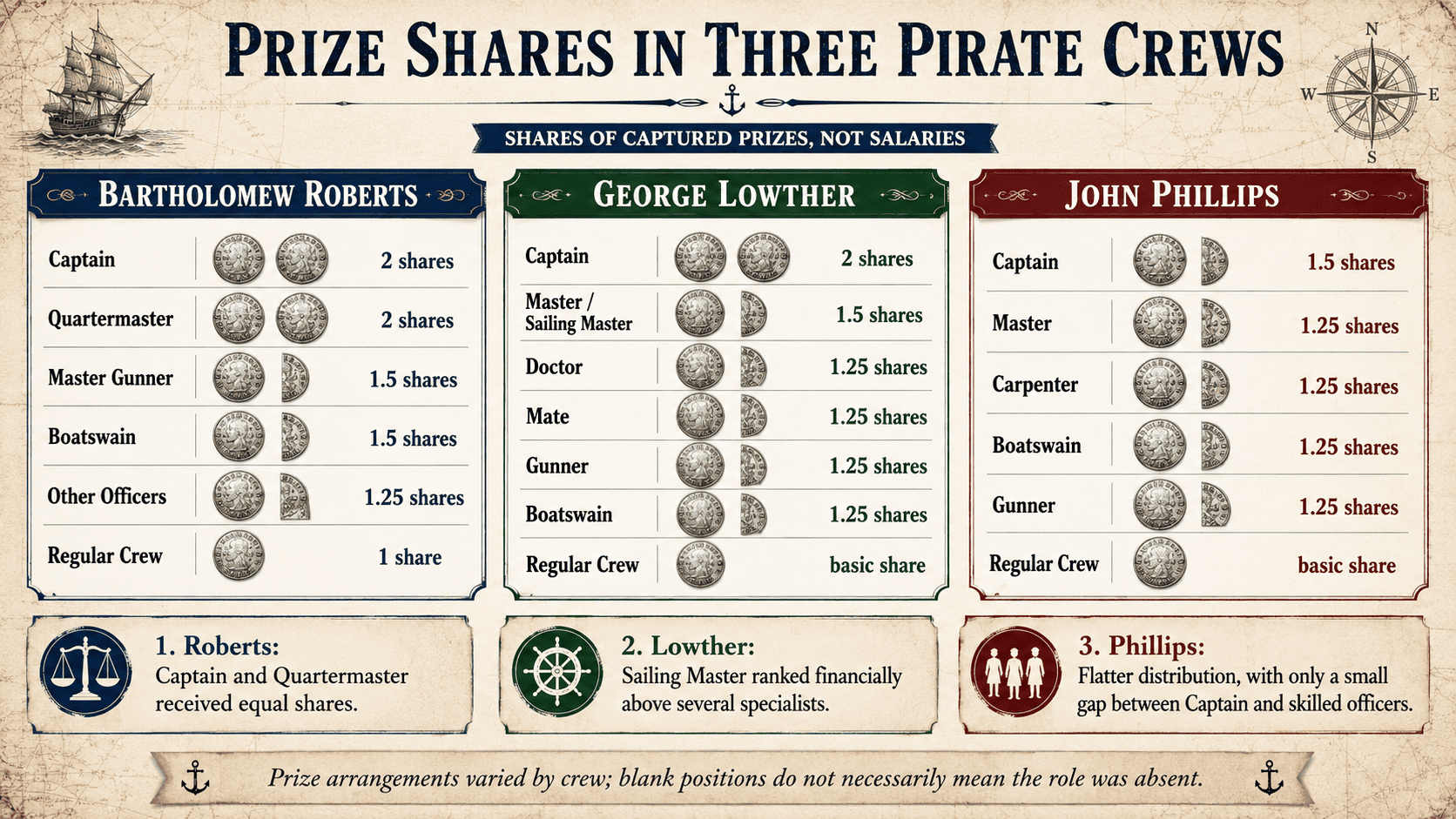
The following examples compare provisions attributed to the crews of Bartholomew Roberts, George Lowther, and John Phillips. A blank entry does not mean that the position was absent; only that the cited distribution rule does not assign it a separate share.
| Position | Bartholomew Roberts | George Lowther | John Phillips |
|---|---|---|---|
| Captain | 2 shares | 2 shares | 1.5 shares |
| Quartermaster | 2 shares | — | — |
| Master / Sailing Master | — | 1.5 shares | 1.25 shares |
| Master Gunner / Gunner | 1.5 shares | 1.25 shares | 1.25 shares |
| Boatswain | 1.5 shares | 1.25 shares | 1.25 shares |
| Carpenter | — | — | 1.25 shares |
| Mate | — | 1.25 shares | — |
| Doctor | — | 1.25 shares | — |
| Other Officers | 1.25 shares | — | — |
| Regular Crew Share | 1 share | Basic crew share | Basic crew share |
Roberts's articles gave two shares each to the captain and quartermaster, one and a half to the master gunner and boatswain, one and a quarter to other officers, and one share to ordinary members of the company. Lowther's articles gave the captain two shares, the master one and a half, and the doctor, mate, gunner, and boatswain one and a quarter each. John Phillips's crew aboard the Revenge gave the captain one and a half shares and the master, carpenter, boatswain, and gunner one and a quarter each.
What Prize Shares Reveal About Pirate Hierarchy
The differences show that responsibility could bring greater financial reward without producing one fixed rank order. Roberts's quartermaster, for example, received the same two shares as the captain, while the master gunner and boatswain received less but still more than an ordinary member. Lowther placed the master above several other specialists, while the doctor, mate, gunner, and boatswain received equal shares. Phillips used a flatter arrangement, with only a half-share separating the captain from the master, carpenter, boatswain, and gunner.
Prize shares therefore provide a practical measure of status within individual crews. Captains often received a premium and skilled officers could earn additional shares, but the size of those rewards depended on the agreement adopted aboard each ship.