
Parts of a Pirate Ship: Anatomy, Names, and Functions
Pirate ships were not a unique class of vessel. During the Golden Age of Piracy, pirates commonly captured merchant ships, naval vessels, and smaller sailing craft, then adapted them for speed, maneuverability, shallow-water access, storage, and combat. Understanding the parts of a pirate ship helps explain how these vessels were sailed, maintained, and used during pursuit and boarding.
This guide identifies the major components of a pirate vessel—including the hull, decks, masts, sails, rigging, and armament—and explains where each part was located, what function it served, and why certain features were especially useful to pirate crews.
Labeled Pirate Ship Diagram
A labeled diagram provides a quick way to identify the main parts of a pirate ship and understand where they were located. Pirate vessels varied in size and design, but ships used during the Golden Age of Piracy shared many structural features with the merchant and naval sailing vessels from which they were captured or adapted.
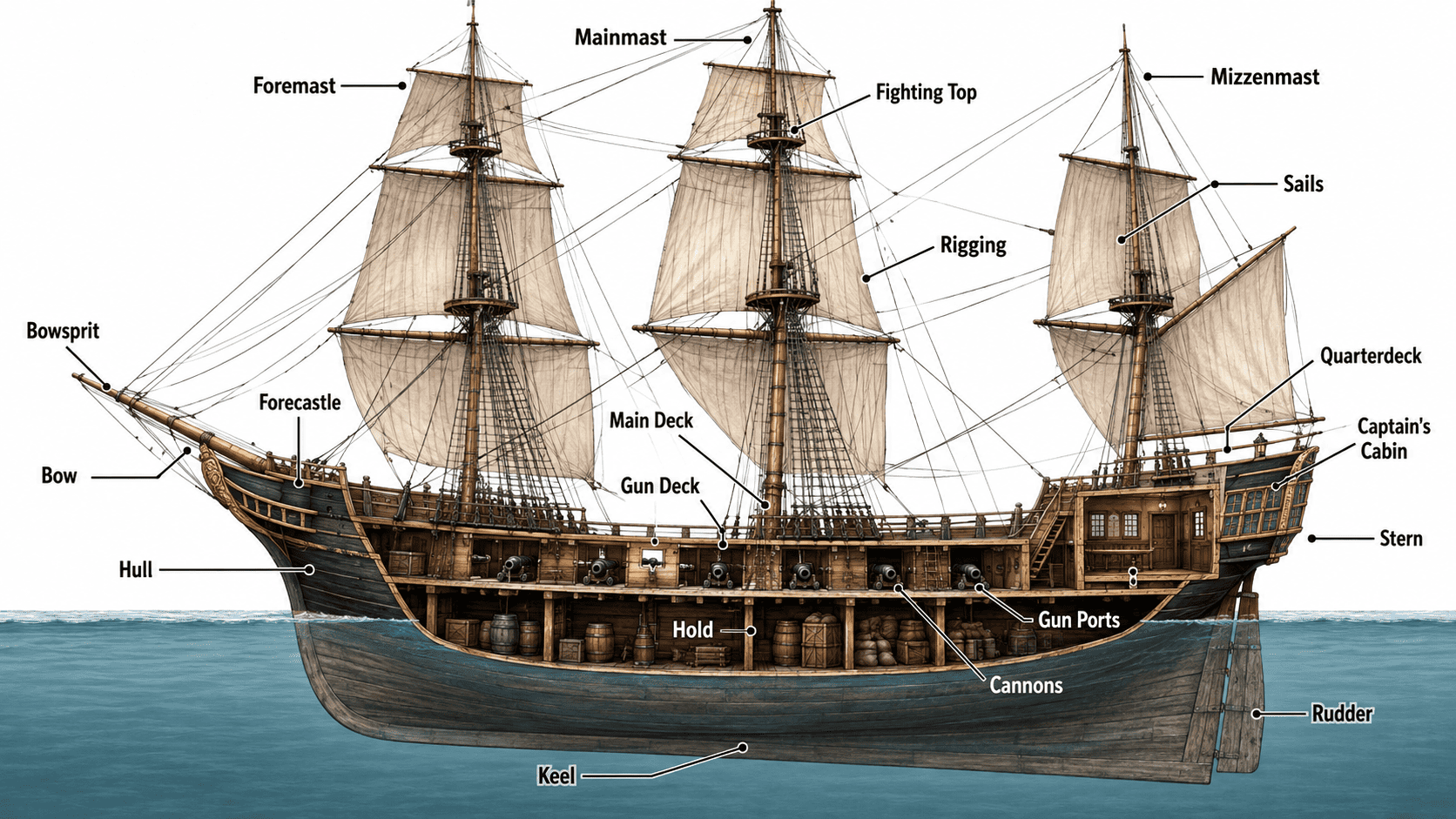
| Part | Location | Main Function |
|---|---|---|
| Bow | Front of the ship | Cut through the water and formed the forward end of the vessel. |
| Bowsprit | Projected forward from the bow | Supported forward sails and parts of the rigging. |
| Hull | Main body of the ship | Provided buoyancy, structural strength, and enclosed internal spaces. |
| Keel | Along the bottom centerline of the hull | Formed the structural backbone of the ship and helped resist sideways movement. |
| Stern | Rear of the ship | Formed the aft section and contained important steering and command areas. |
| Rudder | At the stern, below the waterline | Steered the vessel by redirecting water as the ship moved. |
| Main Deck | Upper working surface | Served as a major area for sailing operations, daily work, and combat. |
| Gun Deck | Deck carrying the main artillery on larger vessels | Held cannons positioned to fire through gun ports along the ship's sides. |
| Quarterdeck | Raised aft section | Provided an elevated working and command area near the stern. |
| Forecastle | Raised forward section | Provided working space near the bow and, on some vessels, crew accommodations. |
| Hold | Inside the lower hull | Stored provisions, water, cargo, equipment, and other supplies. |
| Captain's Cabin | Usually toward the stern | Served as the captain's private living and working space on vessels large enough to have one. |
| Foremast, Mainmast, and Mizzenmast | Rising vertically from the deck | Supported sails and rigging that powered and maneuvered the ship. |
| Sails | Attached to masts, yards, and rigging | Captured wind to propel the vessel and help control its movement. |
| Rigging | Network of ropes and lines around the masts and sails | Supported the masts and allowed the crew to raise, lower, adjust, and control the sails. |
| Fighting Top | Platform high on a mast | Provided an elevated position for lookout duties and, during combat, for crewmen using small arms. |
| Gun Ports | Openings along the sides of armed vessels | Allowed cannons to fire through the hull while permitting the openings to be closed when necessary. |
| Cannons | Primarily along armed decks | Provided the ship's main heavy firepower for disabling, intimidating, or attacking other vessels. |
The Hull: Foundation and Maintenance
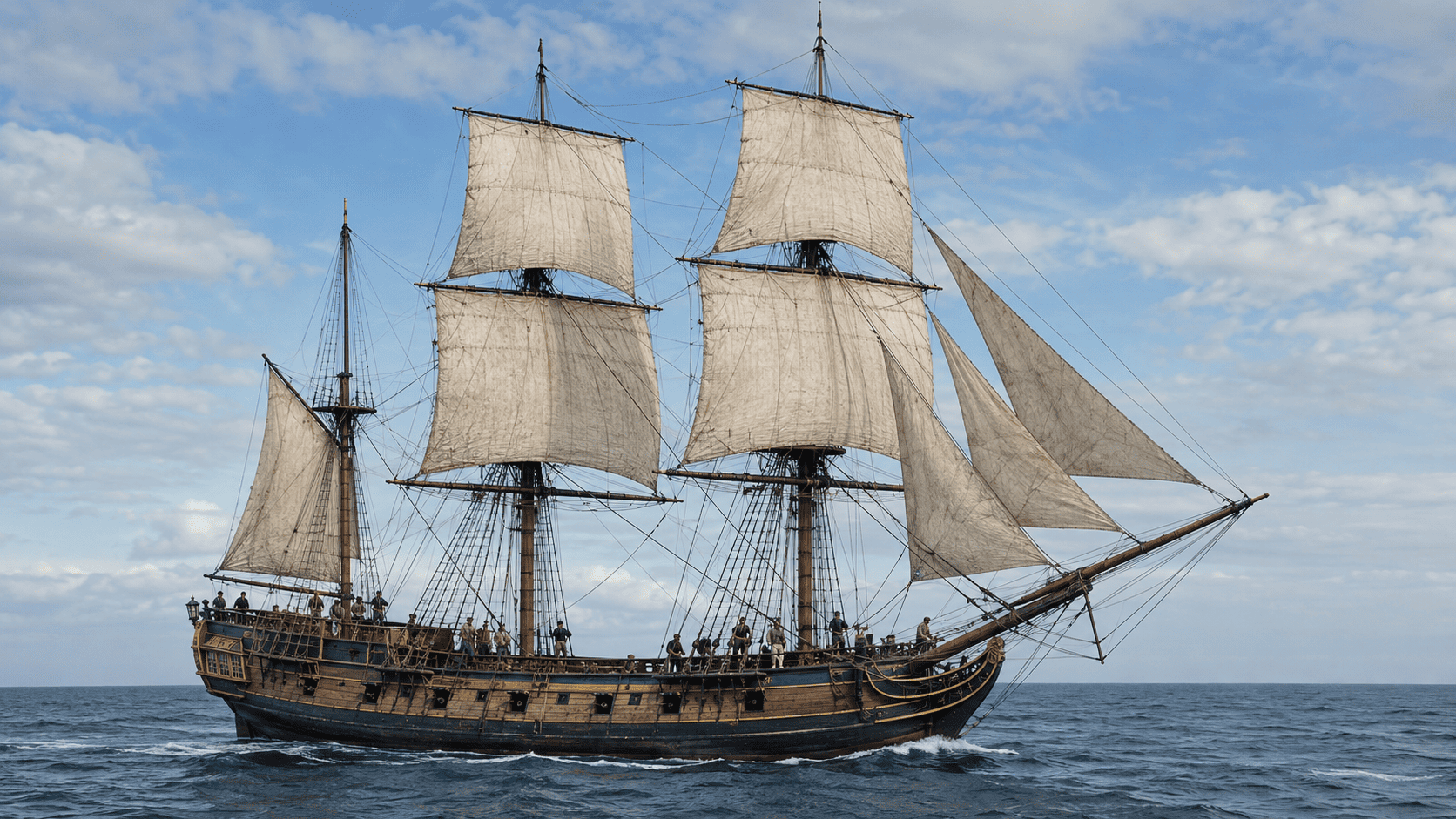
The hull was the main structural body of a pirate ship, supporting everything above the waterline while enclosing the spaces below deck. Pirates did not build a standardized type of “pirate ship”; they usually captured or acquired existing sailing vessels and favored those whose hulls suited their needs. A strong but relatively light vessel could carry provisions, weapons, and crew without sacrificing too much speed, while a shallow draft allowed some ships to enter coastal waters that larger naval vessels could not safely follow.
Hull shape also affected maneuverability and sailing performance. For pirates, these characteristics had practical consequences. A vessel that could accelerate quickly, turn efficiently, and operate close to shore had advantages when pursuing merchant ships, escaping warships, approaching isolated anchorages, or using shallow bays as temporary refuges.
Hull and Keel
The hull formed the watertight body of the ship. On the wooden sailing vessels associated with the Golden Age of Piracy, it consisted of a framework of timbers covered with wooden planking. Its shape determined how the vessel displaced water and influenced its carrying capacity, stability, speed, and draft.
Running along the bottom of the ship was the keel, the principal longitudinal timber around which much of the hull was constructed. Frames rose from the keel to create the vessel's basic skeleton, and planking attached to those frames formed the outer shell.
The keel also helped the vessel resist being pushed sideways by wind. This was especially important for sailing ships, which needed to convert wind acting on their sails into forward motion rather than simply drifting sideways across the water.
Draft—the vertical distance between the waterline and the lowest part of the hull—was particularly important to pirates. Vessels with a relatively shallow draft could navigate closer to shore, enter smaller harbors, and move through waters that posed a grounding risk to deeper-draft ships. This did not make every pirate vessel shallow-drafted, but it helps explain why fast, maneuverable craft were often attractive to pirate crews.
Bow and Bowsprit
The bow was the forward end of the ship. Its shape influenced how the vessel met waves and moved through the water. A well-designed bow reduced resistance and helped the vessel maintain speed, an important consideration for crews whose survival could depend on catching another ship or preventing a pursuer from closing the distance.
Projecting forward from the bow was the bowsprit, a heavy spar that extended beyond the hull. It provided an attachment point for stays and supported sails set ahead of the foremost mast. Moving part of the sail area forward helped balance the vessel's sail plan and gave the crew additional control over sailing performance.
The bowsprit was therefore more than a decorative feature commonly seen in images of old sailing ships. It was an integral part of the vessel's rigging system, connecting the structure of the bow with the sails and lines used to control the ship.
Stern and Rudder
The stern was the rear, or aft, end of the vessel. On many sailing ships of the period, the stern was built higher than the central portion of the deck and could contain officers' or captain's accommodations on larger vessels. Its most important structural connection to navigation, however, was the steering system.
A rudder was mounted vertically at the stern, with much of its surface extending below the waterline. By turning the rudder, the helmsman changed the direction in which water flowed past it, causing the ship to turn.
On vessels of the Golden Age of Piracy, the rudder could be controlled through a tiller or, on ships fitted with one, a ship's wheel connected to the steering mechanism. The effectiveness of the rudder depended partly on the ship's movement through the water; a sailing vessel with little or no forward motion responded less effectively to steering.
For pirates, reliable steering was essential not only during long passages but during pursuits, escapes, approaches to unfamiliar coasts, and close maneuvering around other vessels.
Careening and Hull Maintenance
A wooden hull required regular maintenance. Marine growth such as barnacles and other organisms accumulated below the waterline, increasing drag and reducing sailing performance. Wooden hulls were also vulnerable to deterioration and damage from marine organisms, including shipworms, as well as leaks caused by damaged planking or deteriorated seams.
One important maintenance method was careening. The vessel was brought into shallow water and deliberately heeled onto one side so that part of the underwater hull became exposed. The crew could then scrape away marine growth, inspect the planking, repair damaged areas, and work on seams before exposing the opposite side when necessary.
Careening required a suitable protected location. A vessel immobilized for hull repairs was vulnerable, so secluded beaches, coves, islands, and riverbanks could be valuable places for pirate crews carrying out maintenance away from naval patrols or hostile ships.
Keeping the hull clean had a direct effect on performance. Heavy fouling increased resistance as the vessel moved through the water, reducing speed. For a merchant ship, lost speed could mean a longer voyage; for pirates, it could determine whether they caught a target or escaped a pursuing warship. Hull maintenance was therefore not merely routine upkeep but an important part of keeping a pirate vessel operational.
Decks and Their Functions
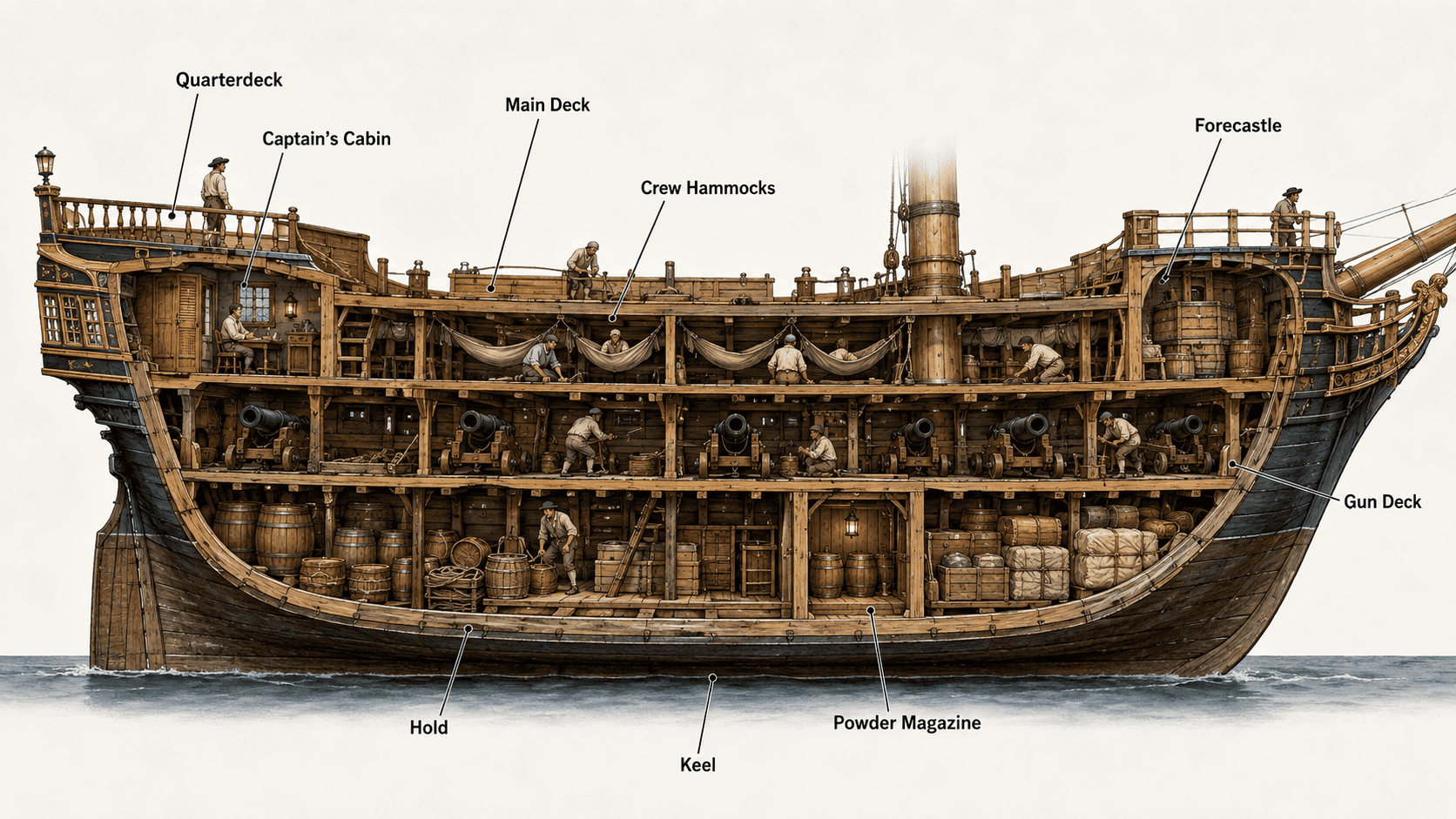
The decks of a pirate ship divided the vessel into working, fighting, storage, and living areas. Their exact arrangement depended on the size and original purpose of the ship, since pirates used everything from small sloops to larger captured merchantmen. On an armed sailing vessel, however, the location of each space affected how quickly the crew could handle sails, move ammunition, fire the guns, store provisions, and prepare for boarding.
Main Deck
The main deck was one of the busiest areas aboard. Crewmen worked the sails and rigging from here, handled anchors and lines, carried out repairs, and performed much of the routine labor needed to keep the ship operating.
During an engagement, the same open space could become a combat area. Men moved between guns, rigging, and boarding positions while officers and experienced crew tried to maintain control of the vessel. If pirates came alongside a target, the deck also provided a staging area for men preparing to cross onto the other ship.
Because pirate crews often carried more men than a merchant vessel normally required, usable deck space was valuable. A larger crew provided manpower for sailing, fighting, and boarding, but it also made an already crowded wooden ship even more congested.
Gun Deck and Gun Ports
Larger armed ships could carry a dedicated gun deck, where cannons were positioned along the vessel's sides. Smaller pirate craft might instead mount their guns on an open deck rather than on a separate enclosed level.
Cannons fired through gun ports, rectangular openings cut into the ship's sides. Hinged covers could close many of these openings when the guns were not in use, helping protect the interior from waves and weather.
The arrangement of the guns determined much of a vessel's broadside firepower. Most heavy cannon fire was directed sideways rather than straight ahead, so a crew had to maneuver the ship into a favorable position before firing effectively.
A gun deck also had to support the considerable weight of artillery, carriages, shot, and related equipment. During combat, crews needed clear access around each cannon so it could be loaded, aimed, fired, and run back into position.
Quarterdeck
The quarterdeck was the raised section toward the stern on many sailing vessels. It offered a commanding view over the deck and surrounding water, making it a useful place for directing navigation and observing an approaching ship.
On naval vessels, the quarterdeck was strongly associated with formal command authority. Pirate ships could operate less formally, particularly when crews elected captains and expected them to share authority with other senior figures, but the physical advantages of the quarterdeck remained the same. From an elevated aft position, the captain or helmsman could better observe sails, crew activity, and nearby vessels.
During a chase or battle, this visibility was especially useful when making decisions about course changes, sail handling, and the ship's position relative to an opponent.
Forecastle
The forecastle, often shortened historically to fo'c'sle, occupied the forward part of the vessel. On earlier sailing ships it could be a noticeably raised structure, while its form varied considerably among later vessel types.
Its position near the bow made it an important working area for handling anchors, forward rigging, and other equipment located at the front of the ship. Men stationed there could also watch the vessel's approach to another ship, coastline, shoal, or anchorage.
The forecastle could provide accommodation for ordinary sailors on some ships, although sleeping arrangements varied widely according to the vessel. Space aboard pirate ships was limited, and areas used for one purpose during the day could serve another function when the crew was off duty.
Hold and Below-Deck Spaces
The hold occupied the lower interior of the hull and was essential for keeping a pirate vessel supplied during a voyage. It could contain barrels of fresh water, salted meat, hardtack, alcohol, spare rope, tools, captured cargo, and other stores needed by the crew.
Heavy supplies were generally kept low in the vessel, where their weight could contribute to stability rather than making the ship unnecessarily top-heavy. Organization also mattered: food, water, ammunition, and repair materials had to remain accessible without allowing loose cargo to shift dangerously as the vessel rolled.
Gunpowder required particular care. On suitably equipped ships, it was stored in a protected powder magazine away from open flames and unnecessary sources of sparks. Powder could then be carried to the guns as needed during combat.
Captured goods might also be placed below deck, but pirates did not normally maintain a special room permanently filled with treasure chests. Valuable cargo depended entirely on what a captured vessel actually carried—coins were possible, but textiles, sugar, tobacco, provisions, weapons, and other trade goods could also be valuable prizes.
Captain's Cabin and Crew Quarters
On larger vessels, the captain's cabin was generally located toward the stern. It could serve as both sleeping space and a place for navigation, planning, keeping charts or documents, and meeting with senior members of the crew.
Pirate captains did not necessarily enjoy the same unquestioned privileges as naval commanders. Many pirate crews operated under written articles that limited the captain's authority outside battle and established how plunder, discipline, and other matters would be handled. Even so, a separate cabin remained useful as a working space when the vessel was large enough to provide one.
Ordinary crewmen usually lived in far less comfortable conditions. Sailors commonly slept in hammocks or other simple arrangements below deck, often in crowded spaces shared with equipment and personal belongings. Hammocks were practical because they could be taken down when not needed, freeing space for work during the day.
Living conditions depended heavily on the size of the ship and the number of men aboard. Pirate crews could be unusually large for the vessels they occupied because additional manpower was valuable in combat and boarding. The result was often cramped accommodation, little privacy, poor ventilation below deck, and constant competition for limited usable space.
Masts, Sails, and Rigging
A pirate ship's masts, sails, and rigging functioned as a single propulsion and control system. The masts supported the sail plan, the sails converted wind into movement, and the rigging allowed the crew to support the spars and adjust the sails as wind and course changed.
For pirates, sailing performance had immediate practical value. A crew needed enough speed to overtake a merchant vessel, enough maneuverability to approach without losing a favorable position, and enough sailing flexibility to escape a more heavily armed opponent. The precise arrangement varied with the type of vessel, so a small sloop did not carry the same rig as a large captured merchant ship.
Foremast, Mainmast, and Mizzenmast
Larger sailing ships commonly carried three principal masts. The foremast stood toward the bow, the mainmast occupied the central portion of the vessel and was usually the tallest, and the mizzenmast stood toward the stern.
Each mast could carry several sails rather than a single sheet of canvas. On a square-rigged vessel, sails were arranged vertically in tiers, allowing the crew to increase or reduce sail area according to wind conditions. Sailors could set additional canvas when they needed more speed or shorten sail when strong winds made a full spread dangerous.
The distribution of sail area among the masts also helped balance the forces acting on the ship. Changing the sails set forward or aft could affect how readily the vessel turned into or away from the wind, giving an experienced crew another means of controlling the ship beyond the rudder alone.
Not every pirate vessel had three masts. Smaller craft could have one or two, and this was not necessarily a disadvantage. A compact rig could require fewer sailors to handle, while a lighter vessel could offer the speed and responsiveness that made smaller ships attractive for raiding and coastal operations.
Square Sails and Fore-and-Aft Sails
Square sails were suspended from horizontal spars called yards and were especially effective when the wind came from behind the vessel or from an angle favorable to broad reaching. Large ocean-going ships could carry several square sails on each mast, producing substantial driving power.
Their limitation was that a square-rigged ship could not sail directly into the wind. To make progress toward a destination lying upwind, the crew had to sail at an angle and change direction repeatedly, a process known as tacking.
Fore-and-aft sails were aligned more closely with the ship's centerline. They generally performed better when sailing closer to the wind and could contribute to quicker handling and maneuverability. Depending on the vessel and rig, such sails could include jibs set forward of the foremast and sails carried from spars such as gaffs farther aft.
Many sailing vessels combined different sail types rather than relying exclusively on one arrangement. This balance mattered to pirates because raw speed was only one part of successful sailing. The ability to change course efficiently, exploit shifting winds, and maintain control during a chase could be just as important.
A pirate crew could also alter its sail plan during pursuit. More canvas could increase speed when conditions allowed, while reducing or rearranging sails could improve control during close maneuvering or worsening weather.
Rigging, Gaffs, Bowsprit, and Yardarms
The rigging was the network of ropes, lines, stays, and other fittings that supported the masts and controlled the sails. It was divided broadly into two functional groups.
Standing rigging helped hold the masts in position. Stays supported them fore and aft, while shrouds provided lateral support. Because the masts carried enormous loads from the sails and wind, this fixed support system was essential to the structural integrity of the rig.
Running rigging consisted of movable lines used to operate the sails and spars. These lines allowed sailors to hoist and lower sails, change their angle, control their edges, and adjust the amount of canvas exposed to the wind. Handling them efficiently required coordinated crew labor, particularly when course or weather changed rapidly.
Horizontal yards crossed the masts and supported square sails. Sailors adjusted these spars to change the angle of the sails relative to the wind. The outer ends of a yard were its yardarms, positions that also became useful points for working aloft.
A gaff was a spar used to support the upper edge of certain fore-and-aft sails. Unlike a square sail hanging from a horizontal yard, a gaff-supported sail could form part of a rig better suited to working at different angles to the wind.
The bowsprit, already structurally connected to the bow, also played an important role in this system. Stays running toward it helped support the forward mast, while jibs and other headsails could be set ahead of the foremast. Extending sail area beyond the bow improved the balance and versatility of the sail plan without requiring another vertical mast.
Damage to the rigging during battle could seriously reduce a ship's ability to maneuver even if its hull remained afloat. Cutting lines, breaking spars, or damaging masts could slow an opponent and make escape more difficult. This made the sailing rig itself an important target during naval and pirate engagements.
Fighting Top and Crow's Nest
Platforms fitted high on the masts gave crewmen an elevated view of the surrounding sea. On sailing warships and armed vessels of the period, a substantial platform at the upper part of a lower mast was properly known as a fighting top.
Its location made it useful for observation, but its function could extend beyond lookout duty. During combat, men positioned aloft could use muskets or other small arms against sailors on an opposing vessel, particularly as ships closed within boarding distance.
The familiar term crow's nest is often used loosely in modern descriptions of pirate ships for any elevated lookout position. Historically, however, it should not automatically be treated as another name for the fighting top. The fighting top was integrated into the mast and rigging of large sailing vessels and could serve both structural and combat purposes.
From an elevated position, a lookout could detect sails, coastlines, reefs, or other hazards earlier than someone standing on deck because the higher viewpoint extended the visible horizon. For a pirate crew searching for potential prizes—or trying to identify a naval vessel before it came dangerously close—early detection could provide valuable time to decide whether to pursue, avoid, or prepare for an encounter.
The Armament: Cannons, Swivels, and Small Arms
A pirate ship's armament was chosen for more than raw firepower. Pirates needed weapons that could stop or intimidate a target without unnecessarily destroying the vessel and cargo they hoped to capture. Heavy artillery therefore worked together with lighter guns and portable weapons, each serving a different purpose as the distance between the two ships closed.
The number and size of guns varied greatly. A small sloop might carry only a handful of cannon, while a captured merchantman or former naval vessel could mount considerably more. Extra artillery increased firepower but also added weight, occupied valuable space, and could reduce sailing performance. For a pirate crew dependent on speed and maneuverability, carrying the largest possible battery was not always an advantage.
Cannons and Gun Ports
Cannons provided the principal heavy firepower aboard an armed pirate vessel. Guns mounted along the sides were positioned to fire through gun ports, allowing several cannon to discharge toward the same side of the ship in a broadside.
Their tactical purpose was not limited to sinking an enemy. Pirates could use cannon fire to damage sails, spars, rigging, or steering equipment, reducing a target's ability to escape. A shot that disabled a merchant vessel without destroying its cargo could be far more useful than one that caused catastrophic damage.
Different forms of ammunition served different purposes. Round shot could damage a hull, guns, or structural timbers, while specialized projectiles such as chain or bar shot were intended to damage masts, sails, and rigging. At close range, anti-personnel loads could be used against exposed crew.
Firing a shipboard cannon required a coordinated gun crew. The weapon had to be loaded with powder and projectile, run into firing position, aimed, discharged, and then controlled as recoil drove the carriage backward. Reloading under combat conditions was physically demanding, especially on a moving wooden vessel filled with smoke, noise, and other men working nearby.
For pirates, cannon fire also had a psychological function. A merchant captain facing a visibly armed ship and an aggressive crew might surrender before either side suffered serious casualties. Capturing the vessel intact preserved both the prize and whatever valuable cargo remained aboard.
Bow Chasers and Swivel Guns
Broadside cannon were most effective when a vessel could bring its side toward an opponent, but a chase created a different problem. A pirate ship pursuing a target needed weapons capable of firing generally forward without first turning away from the pursuit.
Bow chasers were guns positioned to fire ahead from the forward part of a vessel. They could be used during pursuit to pressure a fleeing ship, damage its steering or rigging, or convince its crew that escape was unlikely. Their value came from allowing the attacker to maintain the chase while still using artillery.
A vessel fleeing from an attacker could similarly use stern-mounted chase guns when available, although their arrangement depended on the ship.
Swivel guns were much smaller than standard shipboard cannon. Mounted on pivots along rails, bulwarks, or other suitable points, they could be turned through a wider arc and aimed more quickly at nearby targets.
Because of their smaller size, swivel guns were especially useful at close range. Loaded with small projectiles, they could be directed against exposed sailors, men working the rigging, or groups gathering on deck. Their mobility also made them useful during the transition from an artillery engagement to a boarding action.
Swivel guns did not replace larger cannon. They complemented them: heavy guns could damage the opposing vessel at greater range, while swivels became increasingly effective as the ships drew closer together.
Small Arms and Boarding Combat
Once two vessels were close enough for boarding, the nature of the fight changed. Heavy cannon became less useful, while muskets, pistols, cutlasses, boarding axes, and other hand-held weapons allowed individual crewmen to fight across decks and confined spaces.
Firearms could be used before physical contact to weaken resistance. Muskets fired from the deck or elevated positions could target exposed opponents, while pistols were particularly practical at close range because they were compact and could be carried during boarding.
Pirate crews are strongly associated with the cutlass, a short-bladed sword well suited to the restricted spaces aboard a ship. Its relatively compact form was easier to handle among masts, ropes, railings, and crowded decks than a long battlefield sword. Boarding axes and similar tools could serve both as weapons and as practical equipment for cutting through lines, barriers, or wooden fittings.
The goal of boarding was usually to take physical control of the target. Crews might use grappling lines or maneuver the ships alongside each other before men crossed over the rails. At this stage, the size and aggressiveness of a pirate crew could matter as much as the ship's artillery.
This helps explain why the different weapons aboard a pirate ship should be understood as a sequence rather than as isolated equipment. Cannons could slow or intimidate the target, chase guns could maintain pressure during pursuit, swivel guns and small arms could suppress resistance at close range, and boarding weapons allowed the crew to seize the vessel itself.
Frequently Asked Questions About Pirate Ship Parts
What Type of Ship Did Pirates Usually Use?
Pirates used many types of sailing vessels rather than a single standardized “pirate ship.” Fast sloops and schooners were useful for pursuit and coastal operations, while larger captured merchant or naval ships offered more cargo space and heavier armament.
Where Did Pirates Sleep on a Ship?
Most ordinary sailors slept below deck, often in hammocks that could be removed when the space was needed for work. Larger vessels might provide separate cabins for the captain or senior crew members.
Where Was Treasure Stored on a Pirate Ship?
There was usually no dedicated treasure room. Valuable cargo was stored in the hold or other secure spaces until it could be divided, sold, or exchanged.
What Was the Crow's Nest Used For?
An elevated lookout position allowed sailors to spot distant ships, land, or hazards earlier than crewmen on deck. On ships of the pirate era, the historically appropriate structure was often a fighting top rather than the later-style crow's nest commonly shown in modern illustrations.
Why Did Pirate Ships Need a Shallow Draft?
A shallow draft allowed certain vessels to operate closer to shore and enter waters that deeper ships could not safely navigate. This gave pirates more options for hiding, escaping pursuit, and using secluded coastal anchorages.