
Piracy Timeline: From Ancient Sea Raiders to Modern Piracy
Last updated: September 2026
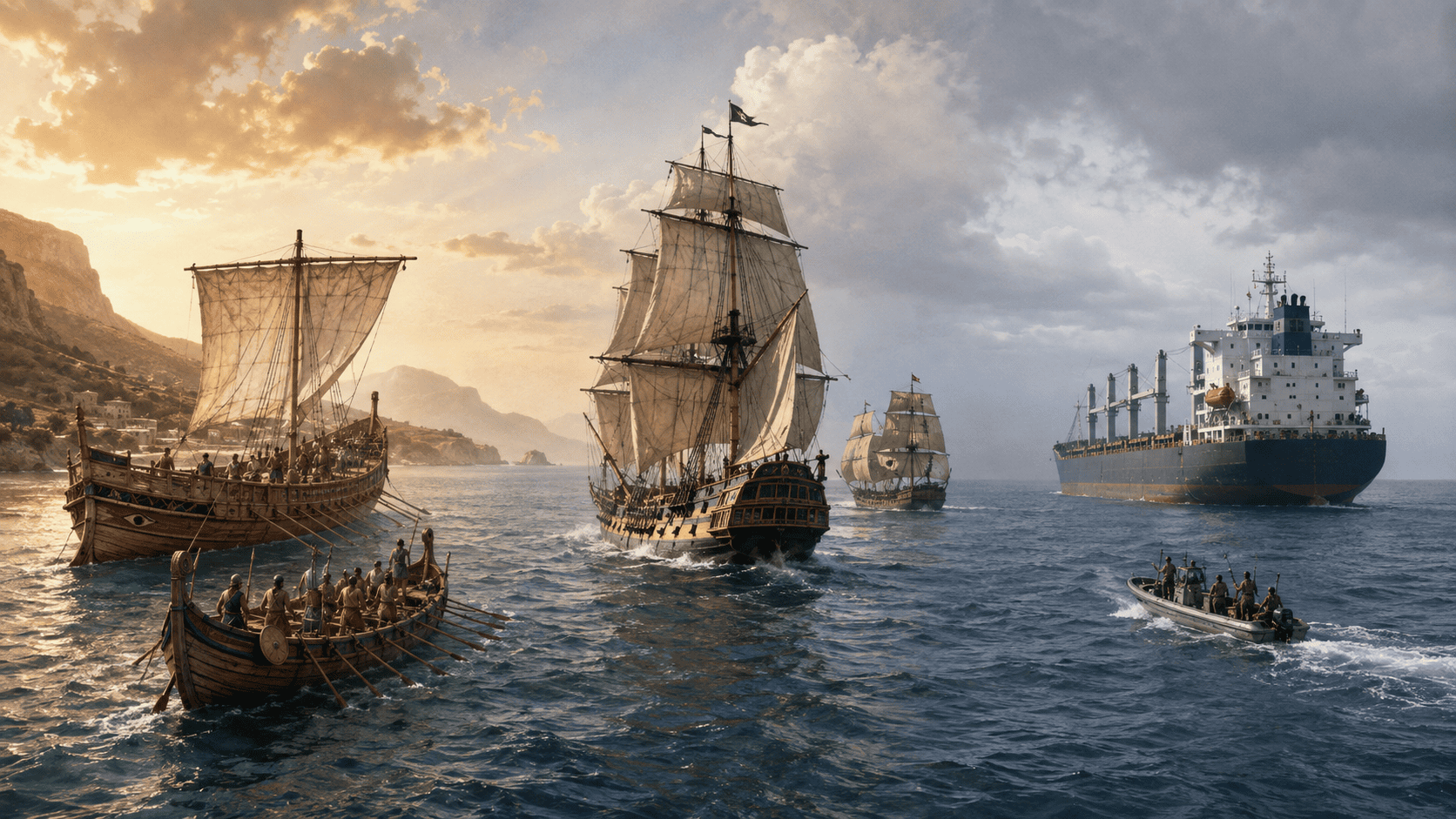
Piracy has existed in documented form for more than 3,000 years, although no single date can be identified as the moment it began. Maritime raiding was recorded in the ancient Mediterranean long before the Caribbean Golden Age, which represents only one chapter in a much longer global history. Piracy continued through the medieval and Early Modern periods, survived the decline of the Golden Age after about 1730, remained active during the nineteenth century, and still threatens commercial shipping today.
This piracy timeline traces the major events and turning points from the ancient world to modern piracy.
Piracy Timeline at a Glance
| Date | Event | Why It Matters |
|---|---|---|
| c. 14th–12th centuries BCE | Early Mediterranean maritime raiding appears in written records | Provides some of the earliest surviving evidence associated with piracy and organized sea raiding. |
| 229 BCE | First Illyrian War begins | Illyrian attacks on shipping help provoke direct Roman military intervention. |
| 67 BCE | Pompey campaigns against Mediterranean pirates | Rome treats piracy as a Mediterranean-wide security and commercial problem. |
| 793 CE | Raid on Lindisfarne | Becomes a major landmark in the history of Scandinavian maritime raiding. |
| 13th–14th centuries | Wokou raids expand in East Asian waters | Shows the importance of piracy, smuggling, and maritime raiding beyond Europe. |
| 1522 | Jean Fleury captures Spanish treasure ships | Demonstrates the vulnerability of Spain's emerging Atlantic treasure routes. |
| 1655 | England captures Jamaica | Port Royal becomes a major base for privateering and Caribbean buccaneering. |
| 1671 | Henry Morgan attacks Panama | Represents the scale and political complexity of late Caribbean buccaneering. |
| 1695 | Henry Every captures the Ganj-i-Sawai | Creates an international diplomatic crisis and becomes a defining event of the Pirate Round. |
| 1718 | Woodes Rogers arrives at Nassau | Ends Nassau's role as a relatively secure large-scale pirate haven. |
| 1718 | Blackbeard is killed at Ocracoke | Becomes a major symbol of intensified colonial suppression of Atlantic piracy. |
| 1722 | Bartholomew Roberts is killed | Removes one of the most successful remaining captains of the late Golden Age. |
| 1801–1805 | First Barbary War | Connects Mediterranean corsairing directly with the early development of U.S. naval power. |
| 1807–1810 | Zheng Yi Sao leads a major South China Sea pirate confederation | Demonstrates the scale of organized piracy outside the Atlantic world. |
| 2008 | Sirius Star hijacked | Shows the expanding operational range of modern Somali piracy. |
| 2009 | Maersk Alabama hijacking | Brings Somali piracy exceptional public attention in the United States. |
| 2026 | Piracy resurges around Somalia and the Gulf of Aden | Confirms that piracy remains an active maritime security threat. |
Ancient Piracy: The Late Bronze Age to Rome
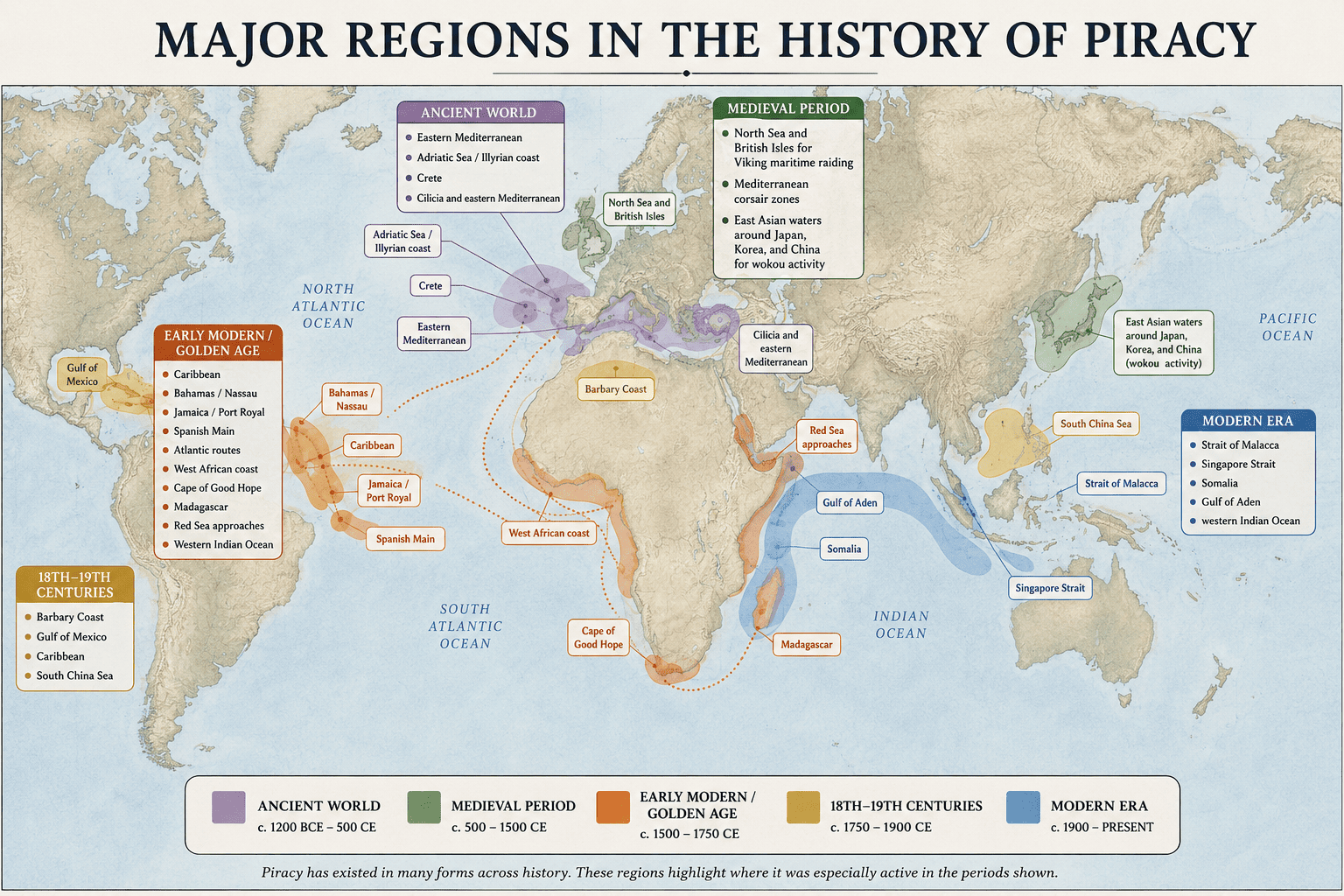
The earliest surviving written evidence commonly associated with maritime piracy comes from the ancient Mediterranean. Ancient sources describe seaborne raiding, attacks on merchant shipping, coastal plunder, and captive-taking centuries before Greece and Rome became dominant Mediterranean powers. The terminology is imperfect: modern historians may recognize piratical behavior in these accounts even when the people involved were also warriors, mercenaries, traders, or participants in larger conflicts.
Early Mediterranean Sea Raiding and the Sea Peoples
Late Bronze Age, c. 14th–12th centuries BCE — Maritime raiding appears in eastern Mediterranean records. Egyptian and Near Eastern texts provide evidence of armed groups operating by sea, attacking coastal communities, interfering with trade, and sometimes serving as mercenaries. These records establish that organized maritime predation was already present in the Late Bronze Age, although applying the modern legal category of “piracy” to every such group would be anachronistic.
Late 13th–early 12th century BCE — The Sea Peoples appear during a period of widespread disruption. Egyptian inscriptions, especially those associated with Pharaohs Merneptah and Ramesses III, describe groups now collectively known as the Sea Peoples participating in attacks and warfare across the eastern Mediterranean.
Some scholars have interpreted at least part of these groups as maritime raiders comparable to pirates or mercenaries. Others emphasize migration, warfare, political upheaval, and the collapse of Late Bronze Age states. Their origins and organization remain debated, so the Sea Peoples should not simply be labeled a single pirate confederation.
What their appearance does demonstrate is that seaborne raiding could operate alongside warfare, migration, and trade during periods when established political systems and maritime routes were under severe pressure.
Illyrian, Cretan, and Cilician Pirates
230s BCE — Illyrian piracy becomes a major Roman concern. Illyrian maritime forces operating along the eastern Adriatic attacked merchant shipping and coastal communities. The historian Polybius describes Italian merchants being robbed, killed, or carried away as captives.
Under Queen Teuta, Illyrian raiding contributed to worsening relations with Rome. After Roman envoys confronted her government over attacks on Italian shipping, tensions escalated into the First Illyrian War in 229 BCE. This episode shows piracy becoming more than a threat to individual merchants: it could provoke direct military intervention by an expanding state.
Hellenistic period — Crete develops a strong association with piracy and captive-taking. Ancient writers repeatedly connected Cretan seafarers with piracy, mercenary activity, and warfare. Evidence must be interpreted carefully because hostile literary sources sometimes exaggerated Cretan lawlessness, but organized piracy was nevertheless an important feature of parts of the Hellenistic Cretan maritime world.
Captives were particularly valuable. Pirates could demand ransom or sell prisoners into slavery, linking maritime raiding directly to the wider Mediterranean slave economy.
2nd–1st centuries BCE — Cilician piracy grows into a Mediterranean-wide problem. Pirate bases associated especially with the southern coast of Anatolia became increasingly important as political instability weakened control of the eastern Mediterranean. Piratical groups targeted merchant shipping, raided islands and coastal settlements, captured people for ransom or slavery, and used protected anchorages and coastal bases.
By the early first century BCE, piracy was no longer merely a collection of isolated attacks. Roman sources describe networks capable of disrupting commerce and threatening communities across large parts of the Mediterranean.
Pompey’s Campaign Against the Pirates in 67 BCE
67 BCE — Rome gives Pompey extraordinary authority to suppress piracy. Persistent attacks on shipping had become serious enough to affect Roman trade and the movement of essential supplies. The tribune Aulus Gabinius proposed the law commonly known as the Lex Gabinia, granting Pompey the Great an exceptionally broad command against the pirates.
Pompey received extensive authority across the Mediterranean and its coastal regions, along with ships, troops, commanders, and substantial financial resources. Rather than pursue pirate groups individually, he divided the sea into operational zones so that Roman forces could act across multiple regions.
The campaign rapidly broke many of the major pirate networks and was followed by operations against their remaining strongholds, particularly in Cilicia. Ancient accounts celebrate the campaign as an exceptionally swift Roman success, although claims that piracy was permanently “eradicated” should be treated cautiously. Maritime raiding continued under the Roman Empire and in later centuries.
67 BCE remains one of the clearest turning points in the piracy timeline because Rome treated piracy as a Mediterranean-wide security and economic problem requiring centralized military action. It established an enduring historical pattern: as maritime commerce expanded, states increasingly responded to piracy not only with local patrols but with coordinated naval power.
Medieval Piracy and Maritime Raiding
The fall of the Western Roman Empire in 476 CE did not end maritime predation. Across the medieval world, coastal raiding continued wherever trade routes, political fragmentation, and accessible coastal settlements created opportunities. The categories are not always straightforward: a crew described as pirates by its victims might have viewed itself as a legitimate war band, a state-supported raiding force, or participants in a religious or political conflict. The important distinction is therefore between independent predation and maritime violence connected to wider warfare.
Viking Raiding, Corsairs, and Mediterranean Piracy
793 CE — The raid on Lindisfarne becomes a major landmark in Scandinavian maritime raiding. Norse attackers struck the monastery off northeastern England, beginning the best-known phase of Viking attacks in Western European records. Similar expeditions subsequently targeted Britain, Ireland, Francia, and other regions.
Viking raiding often overlapped with piracy because armed crews traveled by sea to seize goods and captives. However, Viking activity cannot be classified entirely as piracy. Scandinavian expeditions also involved organized warfare, tribute-taking, conquest, trade, migration, and permanent settlement. By the ninth century, some Viking forces had progressed from short raids to sustained military campaigns and territorial occupation.
7th–10th centuries — Maritime conflict intensifies across the Mediterranean. As Byzantine, Islamic, and later Christian powers competed for islands, ports, shipping lanes, and coastal territory, the Mediterranean became a zone where formal naval warfare existed alongside smaller-scale raiding and corsair activity.
During the ninth and tenth centuries, Muslim fleets and smaller raiding squadrons operated from bases across North Africa, Sicily, Crete, parts of southern Italy, and the eastern Mediterranean. Their activities ranged from state-supported warfare to coastal attacks for booty and captives. Christian seafarers also participated in comparable forms of maritime violence.
The distinction matters because corsair, raider, and pirate were not interchangeable legal categories. Some crews operated with the support or tolerance of rulers, while others attacked primarily for private gain. Captive-taking remained economically important: prisoners could be ransomed, exchanged, or sold into slavery.
11th–13th centuries — The Crusades further blur the boundary between piracy and warfare. Christian and Muslim shipping competed for control of Mediterranean routes, while private maritime forces attacked enemy vessels and coastal positions. Raiding that one political authority regarded as legitimate warfare could be condemned as piracy by the opposing side.
Wokou and Piracy in East Asia
13th–14th centuries — Wokou raids emerge as a major problem in East Asian waters. Known as wokou in Chinese sources and wakō in Japanese, maritime raiders attacked coastal communities and shipping around Korea and China. Early groups were strongly associated with seafarers from western Japan, particularly areas such as Kyushu and Tsushima.
Late 14th century — Raiding affects the coasts of Korea and Ming China. Wokou groups seized goods and grain and also kidnapped coastal inhabitants. Captives could be transported and sold, connecting raiding with regional commercial networks rather than making it simply an act of coastal destruction.
Over time, however, wokou became a misleadingly simple label. Although the term was associated with “Japanese pirates,” later groups could include Chinese, Japanese, Koreans, and other maritime participants. Commerce, smuggling, and piracy increasingly overlapped as governments attempted to restrict private maritime trade.
15th century — East Asian maritime networks continue to connect legal trade with illicit commerce and raiding. Merchants could move between legitimate exchange, smuggling, armed protection, and predatory activity depending on political conditions and access to official markets.
This pattern continued into the sixteenth century, when wokou networks would become even more international and closely connected with Chinese merchants, Japanese silver, Portuguese traders, and Ming restrictions on overseas commerce.
Piracy, Privateering, and Atlantic Expansion
Between the sixteenth and mid-seventeenth centuries, European expansion transformed the geography and economics of maritime raiding. Spanish ships carried American silver and other valuable cargo across the Atlantic, while competing European powers sought ways to disrupt Spain's trade without relying exclusively on expensive royal navies. The result was a maritime world in which piracy, privateering, smuggling, and imperial warfare frequently operated along the same routes—but did not have the same legal status.
Pirates, Privateers, Corsairs, and Letters of Marque
Early 1500s — European expansion creates new opportunities for maritime predation. Spanish conquest in the Americas redirected enormous quantities of bullion and commercial goods through Atlantic ports and shipping routes. France, England, and later the Dutch Republic challenged Spanish power through both formal warfare and privately financed attacks on enemy commerce.
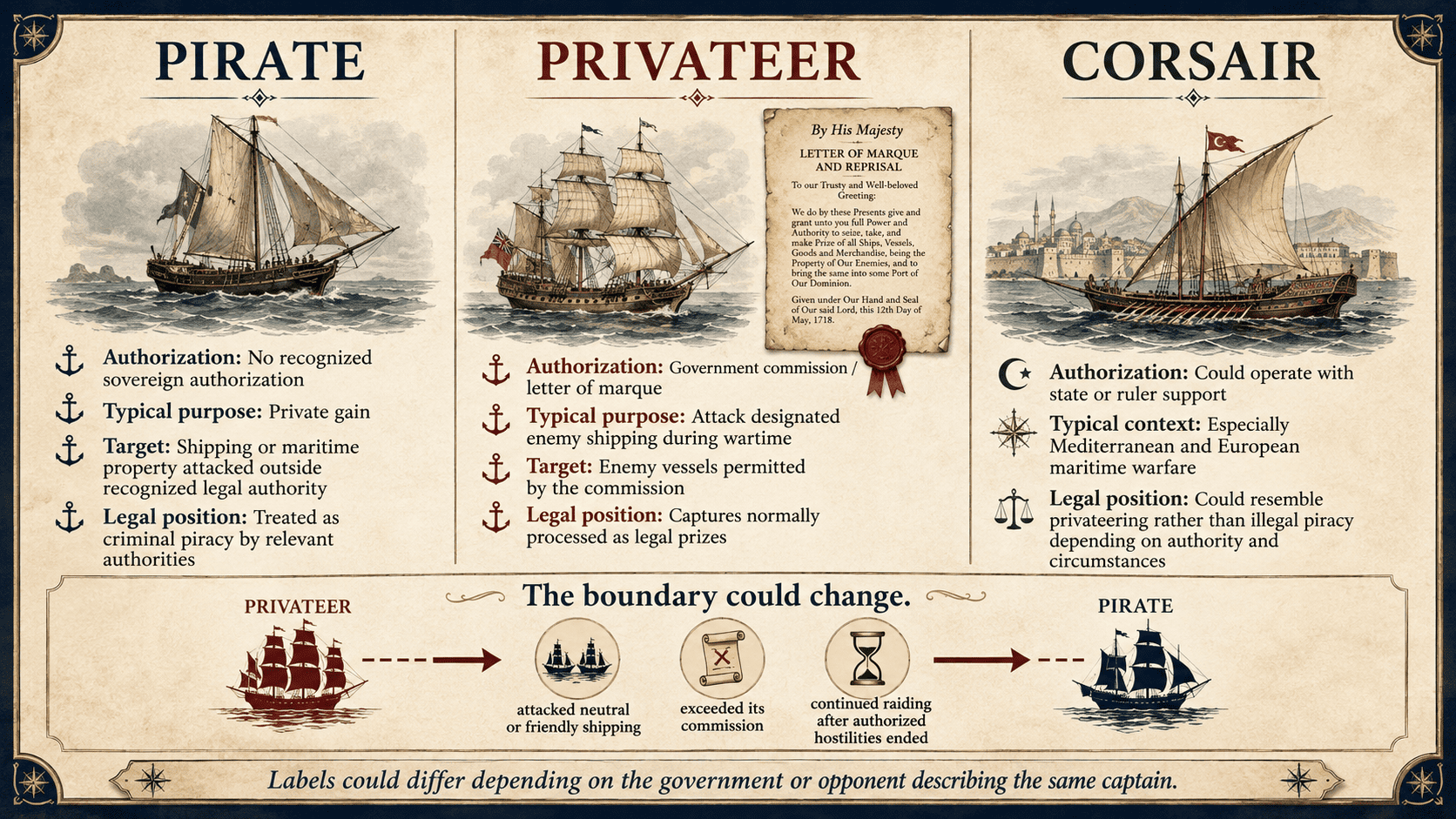
The legal distinctions mattered.
A pirate attacked shipping without recognized sovereign authorization for private gain and could be treated as a criminal by the authorities whose laws applied.
A privateer was a privately owned armed vessel authorized by a government to attack designated enemy shipping during wartime. The authorization was typically expressed through a commission commonly called a letter of marque. Captured vessels and cargo were treated as prizes and were supposed to pass through legal procedures before profits were distributed.
A corsair was another term used for maritime raiders, especially in Mediterranean and European contexts. Corsairs could operate under government authorization, making some of them closer to privateers than pirates. The label therefore does not automatically indicate illegal piracy.
These categories could become politically contentious. A captain commissioned by England to attack Spanish shipping might be regarded as a legitimate privateer by English authorities and as a pirate by Spain. More importantly, a valid commission did not authorize attacks on every vessel. A privateer who attacked neutral or friendly shipping, exceeded the terms of a commission, or continued raiding after a war ended could cross the legal boundary into piracy.
1522 — Jean Fleury captures Spanish treasure ships. The French corsair Jean Fleury intercepted vessels carrying treasure taken from the recently conquered Aztec Empire. His success demonstrated that Spain's emerging Atlantic wealth could be vulnerable before it reached Europe.
Mid-16th century — Spain develops increasingly organized protected convoy systems. Growing threats encouraged the Spanish Crown to concentrate merchant shipping into fleets and provide naval escorts. The treasure fleet system made individual vessels harder targets while concentrating valuable trade around important ports and established routes.
1570s–1580s — English privateering intensifies against Spain. Francis Drake attacked Spanish shipping and settlements under English support, including raids connected with Panama and the capture of the treasure ship Nuestra Señora de la Concepción in 1579. Such expeditions show how state rivalry and private profit could reinforce one another.
Spanish America and the Rise of Caribbean Buccaneers
Late 1500s–early 1600s — Spanish imperial ports become strategic targets. Silver from Peru and Mexico, along with other valuable goods, moved through ports including Veracruz, Cartagena, Portobelo, and Havana. Heavily protected treasure fleets could be difficult to capture at sea, so raiders also targeted ports, smaller vessels, and poorly defended stretches of the Spanish Caribbean.
Early 1600s — Non-Spanish settlers and hunters establish themselves around Hispaniola. Some lived by hunting wild cattle and pigs and preserving meat on wooden racks known by a term that gave rise to the word buccaneer. French and English communities increasingly operated around Hispaniola and nearby islands outside effective Spanish control.
1620s–1630s — Tortuga develops into an important buccaneer base. Located off the northwestern coast of Hispaniola, the island offered a useful position near Spanish Caribbean routes. Communities of hunters, smugglers, sailors, and armed raiders became increasingly connected with attacks on Spanish commerce.
Buccaneers did not fit neatly into a single category. Some operated as unauthorized pirates; others received commissions from French, English, or Dutch authorities and functioned as privateers during periods of war. Their crews could shift between hunting, trading, smuggling, privateering, and outright piracy as political conditions changed.
By the mid-seventeenth century, imperial warfare, profitable Atlantic commerce, loosely controlled Caribbean communities, and experienced armed crews had created the conditions from which the Golden Age of Piracy would develop.
The Golden Age of Piracy Timeline
Historians do not use one universally accepted set of dates for the Golden Age of Piracy. A broad definition places it from roughly the mid-seventeenth century to the 1720s, while narrower definitions focus on the intense outbreak of Atlantic piracy after 1715. The period is best understood as several connected phases: Caribbean buccaneering, the Pirate Round into the Indian Ocean, and the postwar surge that produced many of the pirates now most closely associated with the era.
Buccaneering Era: c. 1650–1680
c. 1650s — Caribbean buccaneers become major maritime raiders. French, English, and Dutch seafarers increasingly used bases in and around Tortuga, Hispaniola, and Jamaica to attack Spanish ships and settlements. Some operated without legal authority, while others received commissions from colonial governors and functioned as privateers during wars with Spain.
This distinction is essential to the timeline: many prominent buccaneers were not simply independent pirates. Governments sometimes encouraged their attacks when they weakened rival empires without requiring the expense of a permanent naval campaign.
1655 — England captures Jamaica from Spain. The English occupation of Jamaica created a strategically important base close to Spanish Caribbean shipping routes. Port Royal developed into a center where privateers and buccaneers could provision ships, recruit crews, sell captured goods, and receive commissions from colonial authorities.
1660s — Buccaneering expands across the Spanish Caribbean. Armed crews attacked shipping as well as Spanish ports and settlements. The most successful expeditions could involve hundreds of men and several vessels, showing that Caribbean buccaneering had developed well beyond isolated robbery at sea.
1668 — Henry Morgan attacks Portobelo. Morgan and his force captured the fortified Spanish port on the Caribbean coast of Panama. The raid demonstrated that buccaneers could attack important imperial positions on land as well as prey on ships.
1670–1671 — Anglo-Spanish relations begin to change while Morgan targets Panama. England and Spain concluded the Treaty of Madrid in 1670, seeking to reduce conflict and unauthorized attacks in the Americas. Communication across the Atlantic was slow, however, and Caribbean military operations did not stop immediately.
January 1671 — Henry Morgan attacks Panama. Morgan led a large force across the Isthmus of Panama and captured Panama City, one of the most ambitious buccaneer operations of the period. Morgan had acted under authority issued in Jamaica during the previous conflict with Spain, but the attack occurred as England was moving toward a more stable diplomatic relationship with the Spanish monarchy.
The political environment that had supported buccaneering was changing. As European governments formalized colonial possessions and sought more predictable commercial relations, officials became less willing to tolerate private attacks that could trigger unwanted wars.
Late 1670s–1680s — State support for Caribbean buccaneering becomes less dependable. Buccaneers did not disappear, but crews increasingly had to choose between legitimate privateering during declared wars, independent piracy, or moving into new regions where valuable shipping was less protected.
Pirate Round: 1690s
1690s — Pirates begin following the “Pirate Round.” Atlantic pirates increasingly sailed around the Cape of Good Hope into the Indian Ocean, where rich Mughal, Arab, Persian, European, and other commercial shipping created opportunities for exceptionally valuable captures.
Madagascar became particularly useful as a place to obtain provisions, repair vessels, exchange goods, and regroup between voyages. The Pirate Round connected Atlantic piracy with commercial routes stretching from the Americas and West Africa to the Red Sea and Indian Ocean.
1693 — Thomas Tew returns from a highly profitable Indian Ocean voyage. Tew's capture of a wealthy vessel during an expedition toward the Red Sea helped demonstrate the potential rewards available on eastern trade routes. Other pirates soon pursued similar opportunities.
May 1694 — Henry Every takes control of the Charles II. Every participated in a mutiny aboard the vessel, renamed it the Fancy, and sailed toward the Indian Ocean. His subsequent career became one of the defining episodes of the Pirate Round.
September 1695 — Henry Every captures the Ganj-i-Sawai. Near the western coast of India, Every's pirate force attacked a Mughal convoy returning from the Red Sea and captured the Ganj-i-Sawai, a heavily laden treasure ship belonging to the Mughal emperor Aurangzeb.
The seizure was historically significant not simply because of the value of the cargo. The attack created a serious diplomatic crisis between the Mughal authorities and the English East India Company. Every became the target of an international search, illustrating how piracy against global commerce could threaten the interests of governments and chartered trading companies far beyond the Caribbean.
1695–1696 — England backs an expedition to hunt pirates in the Indian Ocean. William Kidd received commissions authorizing him to attack pirates and certain enemy vessels. His mission demonstrates the complicated relationship between privateering and piracy: governments sometimes relied on privately financed armed expeditions to suppress maritime predation.
30 January 1698 — William Kidd captures the Quedagh Merchant. Kidd seized the Indian-owned merchant ship while it carried valuable Asian goods under circumstances he argued made it a lawful prize. The capture nevertheless became central to the accusations against him.
Kidd's case became one of the era's clearest examples of the unstable legal boundary between privateer and pirate. His commissions did not provide unlimited authority, and disputes over the legal status of his captures ultimately contributed to his arrest, trial, and execution in England in 1701.
The Final Golden Age Outbreak: 1715–1730
1713–1714 — The War of the Spanish Succession ends. Peace agreements associated with Utrecht and subsequent settlements drastically reduced the legal demand for privateers. Thousands of sailors and armed seamen who had served during the war suddenly faced fewer wartime opportunities.
Some entered merchant or naval service. Others joined pirate crews. The end of the war did not by itself cause piracy, but it created a large pool of experienced maritime labor at precisely the time Atlantic commerce was expanding.
July 1715 — A Spanish treasure fleet is wrecked off Florida. A hurricane destroyed much of a Spanish fleet carrying valuable cargo through the Florida Straits. Spanish salvage teams began recovering treasure from the wrecks, and English raiders including Henry Jennings subsequently targeted the recovery operation.
The episode helped connect several future pirate leaders and contributed to the growth of a new pirate community centered on the Bahamas.
1715–1717 — Nassau emerges as the principal Atlantic pirate haven. With weak colonial government on New Providence, Nassau became a base for pirates including Benjamin Hornigold, Charles Vane, Edward Teach—later known as Blackbeard—and others. From the Bahamas, crews could reach shipping routes connecting the Caribbean, North American colonies, and Atlantic.
This loosely controlled pirate community is often called the “Republic of Pirates,” although it was not a formal republic or internationally recognized state.
1717 — Britain offers a royal pardon to pirates who surrender. George I's proclamation offered clemency under specified conditions while threatening continued pirates with prosecution. The policy attempted to separate men willing to abandon piracy from those determined to continue.
26 July 1718 — Woodes Rogers arrives at Nassau. Appointed governor of the Bahamas, Rogers reached New Providence with governmental authority, military support, and the royal pardon. Many pirates surrendered, while others fled or continued raiding.
His arrival was a major turning point because Nassau could no longer operate as a large, relatively secure pirate base. Colonial administration and anti-piracy enforcement were beginning to work together more effectively.
22 November 1718 — Blackbeard is killed at Ocracoke. A force commanded by Royal Navy Lieutenant Robert Maynard, dispatched under the authority of Virginia governor Alexander Spotswood, fought Edward Teach at Ocracoke Inlet in North Carolina. Blackbeard was killed in the engagement.
His death did not end Atlantic piracy, but it became one of the clearest symbols of the increasingly aggressive colonial campaign against prominent pirate captains.
November 1720 — John “Calico Jack” Rackham's crew is captured and prosecuted in Jamaica. Rackham and members of his crew were convicted of piracy. Rackham was hanged, while Anne Bonny and Mary Read were tried separately on November 28 and sentenced to death. Their executions were postponed after both pleaded pregnancy; Read died in prison in 1721, while Bonny's later fate is uncertain.
10 February 1722 — Bartholomew Roberts is killed off West Africa. Roberts died during an engagement with HMS Swallow under Captain Chaloner Ogle. His crew was defeated, and dozens of captured pirates were subsequently tried.
Roberts had operated across the Atlantic, Caribbean, and West African shipping routes. His death removed one of the most successful remaining pirate commanders and demonstrated the growing reach of organized naval suppression.
1720s — Piracy becomes increasingly difficult to sustain in the Atlantic. Governors denied pirates safe bases, naval vessels hunted major crews, Admiralty courts prosecuted captured pirates, and governments became less willing to tolerate communities that bought stolen cargo or protected offenders.
The decline was therefore institutional as much as military: pirates were progressively losing the ports, markets, political protection, and geographic refuges that had allowed earlier crews to operate.
12 July 1726 — William Fly is executed in Boston. Fly's brief piracy career ended with his conviction and hanging in Massachusetts. Some historians use his execution as a convenient endpoint for the postwar Golden Age.
Other timelines extend the era to around 1730, reflecting the fact that pirate activity did not disappear on one specific date. The Golden Age ended as a gradual collapse of a particular Atlantic pirate system—not as the end of piracy itself.
Piracy After the Golden Age: 1730–1900
The decline of the Atlantic Golden Age did not mark the end of piracy. During the eighteenth and nineteenth centuries, maritime predation remained important in the Mediterranean, Gulf of Mexico, Caribbean, South China Sea, and other heavily traveled waters. What changed was its geography and political environment. Expanding navies and stronger coastal states made large pirate communities increasingly difficult to sustain in some regions, while piracy flourished elsewhere where commercial traffic remained valuable and enforcement was limited.
Barbary Corsairs and the Barbary Wars
18th century — North African corsairing remains a major Mediterranean concern. Algiers, Tunis, and Tripoli supported corsair forces that captured merchant vessels, demanded tribute, and held captives for ransom. Morocco also participated in maritime conflict, although the political relationships among the Barbary states differed.
Calling all Barbary activity simply “piracy” can obscure an important distinction. Much of it was state-supported corsairing, operating within systems of diplomacy, tribute, war, and negotiated protection. European powers simultaneously used their own privateers against enemy shipping.
1785 — Algerian corsairs seize American vessels. After independence, U.S. merchant ships no longer benefited from British naval protection. Algiers captured American ships and held their crews, making Mediterranean security an early foreign-policy problem for the United States.
1794 — Congress authorizes construction of six U.S. Navy frigates. Threats to American commerce from Algerian corsairs were an important factor behind the Naval Act, directly connecting Mediterranean maritime security with the development of permanent U.S. naval power.
1801–1805 — The First Barbary War. Tripoli declared war after a dispute over tribute. The United States responded with naval operations in the Mediterranean and concluded a treaty in 1805 that ended the conflict with Tripoli.
1815 — The United States goes to war with Algiers. After the War of 1812, a squadron under Commodore Stephen Decatur sailed to the Mediterranean, defeated Algerian vessels, and forced a treaty ending U.S. tribute payments and providing for the release of captives.
These campaigns reduced the threat to American shipping but did not instantly end North African corsairing throughout the Mediterranean. Further European pressure followed, including the Anglo-Dutch bombardment of Algiers in 1816.
Zheng Yi Sao and South China Sea Piracy
1805–1807 — Zheng Yi helps consolidate pirate groups in the South China Sea. Rather than functioning only as isolated crews, affiliated fleets coordinated operations across commercial routes connecting southern China, Vietnam, and Southeast Asian markets.
1807 — Zheng Yi dies, and Zheng Yi Sao emerges as the confederation's dominant leader. Working closely with Zhang Bao, she maintained control over a large network capable of attacking merchant vessels, raiding coastal communities, demanding protection payments, and challenging Qing naval forces.
Fleet and manpower estimates vary widely, so precise claims about the number of ships or pirates should be treated cautiously. What is clear is that the organization operated on a scale far beyond that of most individual Atlantic pirate crews.
1808–1809 — The confederation withstands repeated Qing campaigns. Government attempts to destroy the pirate organization militarily struggled to achieve decisive results, while disruption to trade and coastal communities increased pressure on Qing authorities to find another solution.
1810 — Zheng Yi Sao negotiates her surrender. Internal divisions, increased Qing pressure, and Portuguese and other naval involvement weakened the confederation. Rather than being captured and executed, Zheng Yi Sao negotiated terms under which large numbers of pirates surrendered and received pardons.
The settlement dismantled one of the largest organized pirate systems of the nineteenth century without requiring its complete destruction in battle.
Caribbean and Gulf Piracy in the Early 1800s
Early 1810s — Barataria becomes a major smuggling and privateering center near New Orleans. Jean Lafitte and his associates operated from the wetlands and islands of southern Louisiana, moving captured and smuggled goods through commercial networks connected with New Orleans.
Lafitte illustrates why legal labels remained complicated after the Golden Age. He was associated at different times with privateering, smuggling, and piracy, rather than fitting neatly into a single category.
1812–1815 — The War of 1812 transforms Lafitte's political position. British officers attempted to recruit him, but Lafitte instead offered assistance to the United States. His Baratarians supplied artillery expertise and other support during the defense of New Orleans.
January 1815 — Baratarians participate in the Battle of New Orleans. President James Madison subsequently pardoned many of Lafitte's associates for offenses against the United States.
Late 1810s — Lafitte resumes operations from Galveston Island in Spanish Texas. The Gulf of Mexico remained a contested maritime environment involving privateers, smugglers, revolutionaries, and pirates.
1820 — U.S. naval pressure forces Lafitte from Galveston. His removal formed part of a broader effort to bring Gulf commerce under stronger government control.
Naval Suppression and Regional Piracy in the 19th Century
1820s — Anti-piracy patrols intensify in the Caribbean and Gulf of Mexico. The U.S. Navy deployed forces to protect merchant shipping, escort vessels, attack pirate bases, and pursue raiders operating from islands and coastal refuges. Britain and other maritime powers also increased enforcement in important commercial waters.
1830 — French forces capture Algiers. The conquest dismantled the political system that had sustained Algerian corsairing, marking another major regional transition in Mediterranean maritime security.
During the remainder of the nineteenth century, larger professional navies, steam-powered warships, improved communications, stronger port administration, and expanding state control of coastlines made sustained piracy increasingly difficult along many major international trade routes.
But this was a regional decline, not a worldwide disappearance. Piracy and armed maritime raiding persisted in parts of Asia, the Pacific, and other waters where governments struggled to control coastlines and shipping lanes.
By 1900, the large pirate havens and semi-independent maritime confederations characteristic of earlier centuries had become harder to maintain. Piracy had been suppressed across many strategic routes, but the practice itself had survived and would reappear prominently wherever valuable shipping met weak maritime security in the modern era.
Modern Piracy: 20th Century to the Present
Modern piracy data in this section is current through August 24, 2026.
Modern commercial shipping did not make piracy obsolete. During the late twentieth and early twenty-first centuries, attacks became concentrated around strategic shipping lanes and regions where heavy maritime traffic intersected with limited enforcement, political instability, or opportunities for criminals to board commercial vessels. Southeast Asia and the waters off Somalia became two of the most important modern piracy hotspots, although the character of incidents differed substantially between them.
Southeast Asia and the Strait of Malacca
Late 1990s–early 2000s — Piracy and armed robbery become a major concern in Asian shipping lanes. The Strait of Malacca and Singapore Strait form part of one of the world's busiest maritime corridors, carrying commercial vessels between the Indian Ocean and the South China Sea. Dense traffic and narrow passages created opportunities for criminals to approach merchant ships, particularly at night or while vessels were moving slowly.
Many incidents involved boarding ships to steal equipment, stores, valuables, or engine parts rather than hijacking vessels for prolonged ransom operations. This distinction also matters legally because many attacks occurred within territorial waters and are therefore classified as armed robbery against ships rather than piracy under international law.
2004 — Regional states strengthen coordinated patrols in the Malacca Strait. Indonesia, Malaysia, Singapore, and later Thailand developed cooperative patrol arrangements aimed at improving surveillance and response across the heavily traveled waterway.
2006 — The ReCAAP Information Sharing Centre begins operations in Singapore. The Regional Cooperation Agreement on Combating Piracy and Armed Robbery against Ships in Asia created a government-to-government framework for information sharing, capacity building, and regional cooperation.
Improved patrols and coordination helped reduce attacks from earlier peaks, although incidents never disappeared from Southeast Asian waters.
2025 — Incidents rise sharply in the Straits of Malacca and Singapore. ReCAAP recorded 108 sea robbery incidents in these straits during 2025, the highest total there during its 2007–2025 reporting period. Most were relatively low-severity incidents, but the increase demonstrated that even heavily monitored modern shipping corridors remain vulnerable.
Somali Piracy and the Gulf of Aden
1991 onward — The collapse of Somalia's central government creates prolonged maritime insecurity. Weak state institutions and limited coastal enforcement contributed to conditions in which organized pirate groups could develop. By the mid-2000s, piracy based along the Somali coast had evolved into a sophisticated ransom business targeting international merchant shipping.
2007–2008 — Somali piracy expands rapidly. Pirate groups increasingly used captured vessels as mother ships, allowing smaller attack craft to operate hundreds of miles from the coast and reach major routes through the Gulf of Aden and western Indian Ocean.
15 November 2008 — Somali pirates hijack the Sirius Star. The Saudi-owned supertanker was captured far from the Somali coast while carrying approximately two million barrels of crude oil. Its size and the distance of the attack demonstrated how dramatically Somali pirates had extended their operational range.
8 April 2009 — Pirates seize the U.S.-flagged Maersk Alabama. The crew regained control of the cargo ship, but Captain Richard Phillips was taken hostage aboard a lifeboat. On April 12, U.S. Navy SEAL snipers operating from the destroyer USS Bainbridge killed three pirates and rescued Phillips.
The incident brought Somali piracy exceptional public attention in the United States and highlighted the growing international security response in the region.
2010–2011 — Somali piracy reaches its peak. Pirates operated across an enormous area extending from the Gulf of Aden deep into the Indian Ocean. In 2011, the International Maritime Bureau recorded 237 incidents attributed to Somali pirates, and the first quarter of that year produced record global piracy figures.
International naval deployments, improved coordination, armed security teams, vessel-hardening measures, safer routing practices, and prosecutions subsequently made successful hijackings much more difficult.
2012–2013 — Somali attacks decline sharply. By 2013, IMB recorded only 15 incidents off Somalia, compared with 237 two years earlier. The decline was dramatic, but it did not mean that the networks and conditions capable of supporting piracy had disappeared permanently.
Piracy in the 2020s
2023–2024 — Somali piracy shows signs of renewed activity. After years of relatively limited successful attacks, hijackings and attempted boardings again demonstrated that Somali groups retained the ability to operate far offshore when conditions allowed.
At the same time, Southeast Asia continued to record frequent incidents against commercial vessels, particularly around the Singapore Strait. Modern maritime security therefore involves several distinct regional threats rather than one global form of piracy.
January–June 2026 — Global reported incidents fall, but Somali piracy resurges. The International Maritime Bureau recorded 38 incidents of piracy and armed robbery against ships worldwide during the first half of 2026, the lowest first-half figure since 1992. Twenty-seven vessels were boarded, five were hijacked, three were fired upon, and three attacks were attempted.
The lower global total concealed a significant regional danger. Somali pirates accounted for 94% of all crew taken hostage during the reporting period, demonstrating that groups operating from the Horn of Africa remained capable of serious long-range attacks.
April–August 2026 — Hijackings increase around Somalia, the Red Sea, and Gulf of Aden. The International Maritime Organization reported a resurgence of piracy in the region. Following the hijacking of the SEAMULL on August 20, the IMO reported on August 24, 2026, that six vessels were being held by pirates or armed robbers and more than 90 seafarers remained captive.
Modern legal distinction: international maritime reporting separates piracy, which under the relevant legal framework occurs on the high seas or outside a state's jurisdiction, from armed robbery against ships, which occurs within a state's internal, archipelagic, or territorial waters. Statistics commonly discussed as “modern piracy” may include both categories, so totals from different organizations and regions must be interpreted carefully.
The events of 2026 show why a piracy timeline cannot end with Blackbeard, the Barbary Wars, or even the Somali crisis of 2008–2011. Maritime piracy has changed in scale, geography, organization, and methods, but it remains an active security threat to commercial shipping in the twenty-first century.