
Viking Pirates: Raids, Ships, Tactics, and the Viking Age
Many Vikings were Scandinavian seaborne raiders whose activities overlapped strongly with piracy, but Viking was not simply the name of a nation of pirates. Scandinavians also traveled as traders, settlers, mercenaries, explorers, and conquerors. During the Viking Age, from the late eighth century into the eleventh century, raiding became one of the most visible forms of Scandinavian expansion. The attack on Lindisfarne in 793 is commonly used as an early landmark, while later expeditions grew from small coastal raids into larger fleets, armies, tribute demands, conquest, and settlement.
This article explains why Viking raiding developed, how ships and tactics made it effective, what raiders targeted and took, where they expanded, and why Viking raiding eventually declined.
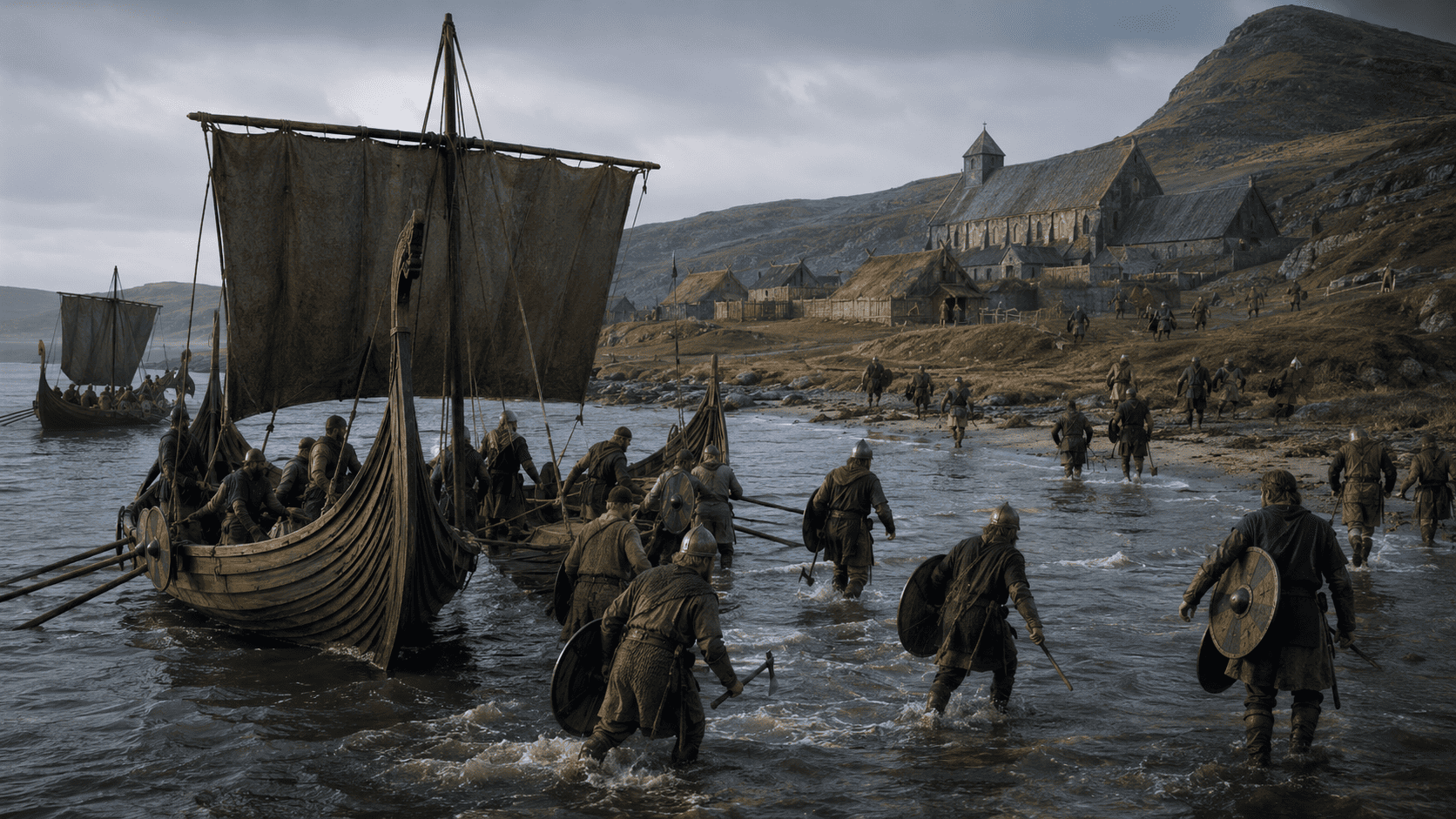
Were the Vikings Pirates?
The key historical distinction is between Scandinavian identity and Viking activity. A farmer, merchant, craftworker, or landowner living in Scandinavia during the Viking Age was not automatically a Viking in the narrower historical sense. Some Scandinavians joined armed overseas expeditions for part of their lives and later returned to farming, trade, political service, or other occupations.
The activities associated with Viking expeditions could include raiding, plunder, captive-taking, and attacks on coastal communities. Those actions can reasonably be compared with piracy, but Viking activity also developed into organized warfare, tribute-taking, conquest, settlement, and service under kings.
For that reason, pirate is useful when describing particular Viking raiders or expeditions, but it is too narrow to describe the entire Scandinavian world of the Viking Age.
What Did the Word “Viking” Mean?
The modern English word Viking is connected with Old Norse terms including víkingr, referring to a person involved in such expeditions, and víking, associated with the activity or expedition itself. Old Norse usage could distinguish this kind of armed venture from an ordinary commercial voyage.
The expression fara í víking, commonly rendered as “to go Viking” or “to go on a Viking expedition,” was associated with leaving home as part of an expedition that could involve raiding and the acquisition of wealth by force. This supports the idea that Viking identity was closely linked to activity rather than functioning simply as a blanket ethnic label for everyone living in Scandinavia.
However, it is too simplistic to state that “Viking literally means pirate.” Scholars continue to debate the deeper etymology of the word. Proposed origins have connected it with Old Norse vík, meaning a bay or inlet, with the region known as Viken around the Oslo Fjord, and with other linguistic explanations. No single derivation should be presented as conclusively established.
Historical usage also varied. People encountering Scandinavian raiders did not consistently call them Vikings. Medieval sources might instead identify them as Danes, Northmen, heathens, foreigners, or by other regional and political labels. The modern habit of using Viking for nearly the entire Scandinavian world of the eighth through eleventh centuries is much broader than some medieval uses of the term.
Viking vs. Norseman vs. Pirate
A Norseman or Scandinavian is the broader historical description. It can refer to people belonging to the societies of Denmark, Norway, Sweden, and related Norse-speaking communities during the period, regardless of whether they ever participated in a raid.
A Viking, in the narrower sense, was associated with overseas expeditions and especially armed raiding. This is why the statement not every Scandinavian was a Viking is historically useful. Scandinavian communities depended on farmers, merchants, craftspeople, political leaders, household workers, and others whose lives cannot be reduced to maritime raiding.
A pirate is a useful analytical comparison for Viking raiders who used ships to attack and seize wealth, but the categories do not match perfectly. Medieval political authority, warfare, tribute, private violence, and raiding did not operate under exactly the same legal framework used to define piracy in later periods.
Nor was every Norse voyage a raid. Scandinavian merchants traveled through extensive trading networks, settlers migrated to new lands, explorers crossed the North Atlantic, and warriors sometimes entered foreign military service. Describing all of these people as “Viking pirates” would erase the distinction between raiding and the many other forms of Scandinavian activity during the Viking Age.
Why Did Viking Raiding Begin?
Viking raiding did not begin for a single reason. The first major Scandinavian attacks recorded in Western Europe emerged in the late eighth century from a combination of economic opportunity, political competition, expanding maritime connections, and demand for wealth and captives. Raiding was risky and required ships, equipment, and organized manpower, but a successful expedition could return with silver, valuable goods, livestock, and enslaved people.
Older explanations sometimes portrayed the raids primarily as a response to poverty, overpopulation, or insufficient farmland in Scandinavia. Environmental and demographic pressures may have mattered in particular regions, but they do not adequately explain the wider phenomenon. Scandinavian societies were becoming increasingly connected to prosperous commercial networks, while ambitious leaders had strong incentives to acquire portable wealth that could reward followers and strengthen their political position.
Wealth and Political Opportunity
Western Europe contained concentrations of wealth that could be attractive to Scandinavian raiders. Monasteries, churches, royal estates, trading settlements, and prosperous communities accumulated silver, coins, metalwork, livestock, supplies, and other movable goods. Wealth that could be transported or redistributed was particularly useful to leaders seeking to finance expeditions and maintain loyal fighting groups.
Political conditions also created opportunities. Early medieval Europe was divided among kingdoms and local powers whose ability to defend long coastlines varied considerably. A wealthy site did not necessarily have a permanent military force capable of responding quickly to an unexpected attack.
At the same time, Scandinavian politics were competitive. Kings, regional rulers, chieftains, and other elites relied partly on networks of followers whose loyalty could be strengthened through gifts, feasting, prestige, and access to wealth. Overseas expeditions offered one way to obtain resources beyond what could be generated locally.
This does not mean every raid was launched as part of a carefully designed political strategy. Motives could differ between expeditions and participants. Personal enrichment, reputation, elite competition, military service, and political ambition could all overlap.
Trade Networks and Knowledge of Foreign Coasts
Trade and raiding should not be imagined as completely separate Scandinavian worlds. Long before and during the Viking Age, merchants connected Scandinavia with the North Sea, Baltic, Western Europe, and routes extending through Eastern Europe. Trading centers such as Ribe and Hedeby became important nodes linking Scandinavian communities with goods and information from distant regions.
Those connections could provide more than commercial products. Sailors and merchants accumulated practical knowledge about coastlines, harbors, river routes, settlements, markets, and political conditions. Information about prosperous communities or weakly protected areas could make foreign expeditions easier to plan.
The same broad maritime networks could therefore support peaceful exchange in one context and violent acquisition in another. A Scandinavian might trade abroad, participate in an armed expedition, or move between different forms of overseas activity at different stages of life.
This overlap helps explain why Viking expansion cannot be reduced to either commerce or piracy. Trade created wealth and connections, while raiding could feed goods and captives back into trading networks.
Slavery and Captive-Taking
People themselves could be among the most valuable prizes taken during Viking expeditions. Slavery was an established part of Viking Age society, and enslaved people were commonly known as thralls. Captives could be retained for labor, exchanged, ransomed, or sold through wider commercial networks.
Raids in the British Isles provided opportunities to seize men, women, and children, while Scandinavian activity through Eastern Europe also became closely connected with slave trading. Captives could eventually pass through major commercial centers and into markets far removed from the places where they had originally been seized.
This economic dimension is important because popular accounts often reduce Viking plunder to silver, gold, and religious treasures. Human capture could also generate wealth. Enslaved people performed agricultural, household, and other labor, while slave trading linked violent expeditions directly to commercial exchange.
Raiding was therefore supported by an economic system in which several kinds of portable wealth had value. Precious metals could be carried home, goods could be traded or redistributed, and captives could be incorporated into households or sold. The combination of profitable targets abroad and expanding networks through which acquired wealth could circulate helped make overseas raiding increasingly attractive during the early Viking Age.
How Viking Pirates Raided
Viking raiding worked best when attackers could exploit mobility, surprise, and local weakness rather than fight a prolonged battle against a prepared army. Early raiding forces could approach from the sea or along navigable rivers, land quickly, seize portable wealth and captives, and return to their ships before defenders could organize an effective response. Over time, however, this pattern expanded into larger and more sustained military operations involving fleets, winter camps, tribute demands, and territorial conquest.
Why Monasteries and Coastal Sites Were Attractive Targets
Monasteries became prominent Viking targets not because Scandinavian raiders had a unique strategic interest in attacking Christianity, but because many religious communities combined valuable portable property with limited military protection.
Churches and monasteries could possess silver vessels, reliquaries, ornaments, coins, livestock, food stores, and other goods that could be removed relatively easily. Some religious communities were also located near coasts, river mouths, or navigable waterways, making them accessible to attackers arriving by ship.
Lindisfarne, an island monastery off the northeast coast of England, illustrates the attraction of such targets. Its 793 raid became famous partly because of the shock preserved in Christian accounts, but from an operational perspective it was also a wealthy religious community exposed to sudden attack from the sea.
Monasteries were not the only targets. Coastal settlements, trading sites, farms, estates, and eventually towns could also attract raiders. Target selection depended on the likely value of the prize, the defenses present, the accessibility of the location, and the raiders' ability to withdraw safely.
Longships, Oars, and Shallow-Draft Mobility
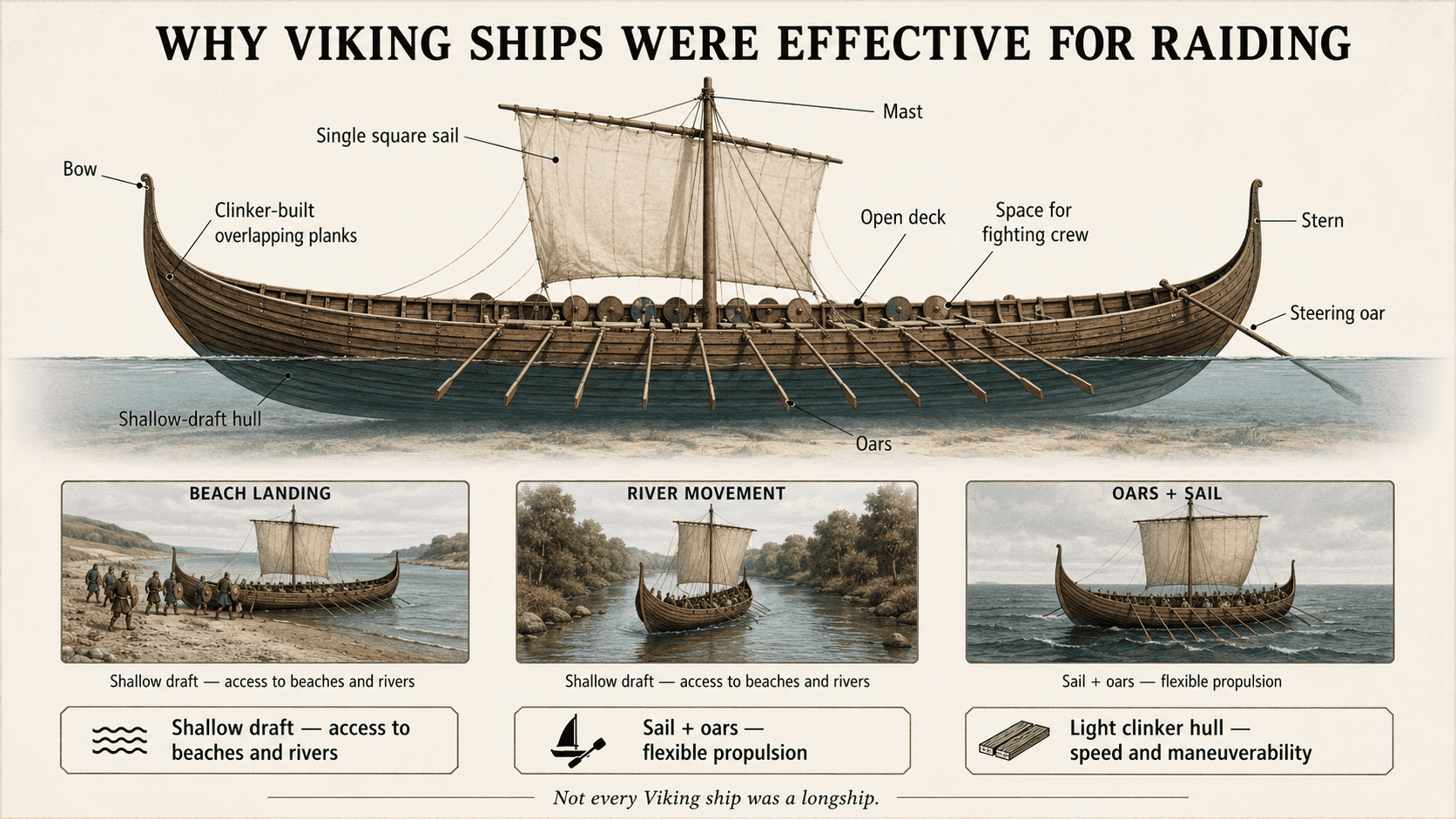
Ships made this raiding system possible. Viking warships combined sails and oars, allowing crews to exploit favorable winds but continue moving when wind conditions were poor or precise maneuvering was necessary.
Many Scandinavian warships had long, relatively narrow hulls and shallow drafts. Their construction commonly used the clinker technique, in which overlapping wooden planks were fastened together to produce a hull that could be strong yet relatively light and flexible.
Shallow-draft vessels could approach beaches without requiring developed harbors and could enter rivers that deeper ocean-going ships could not navigate as easily. Crews could therefore arrive close to a target instead of unloading far offshore. Oars also gave commanders greater control during landings, departures, river navigation, and situations where relying exclusively on wind would have been impractical.
Not every Viking ship was a longship. Scandinavian maritime activity also depended on cargo ships and other vessels designed for transport, commerce, and coastal movement. Longships were particularly associated with warfare and the movement of fighting crews, but Viking fleets could include vessels serving different purposes.
This distinction became increasingly important as expeditions grew larger and had to transport not only warriors but also food, equipment, animals, trade goods, and other supplies.
Surprise Attacks and Rapid Withdrawal
A relatively small raiding force did not need to defeat an entire kingdom. It needed to attack a vulnerable location before local authorities could concentrate enough men to stop it.
A typical small-scale operation could follow a simple sequence:
approach by sea or river → land quickly → attack the target → seize valuables and captives → return to the ships → withdraw.
Surprise reduced the amount of resistance the raiders had to overcome. Coastal communities could not maintain large defensive forces everywhere, and communication between settlements and regional rulers was slow compared with the speed at which an armed crew could land and begin an attack.
The ships also served as an immediate escape route. Raiders who remained close to navigable water could withdraw before larger defensive forces arrived. If local resistance became stronger than expected, abandoning the attack could be more sensible than fighting for control of territory.
This pattern helps explain why mobility mattered as much as battlefield strength during the earliest phase of Viking raiding. The objective was often to obtain wealth while minimizing the time spent exposed to an organized counterattack.
Plunder, Captives, Ransom, and Tribute
The profits of a Viking raid were not limited to gold and silver. Raiders could take coins, precious metal, weapons, livestock, food, clothing, tools, supplies, and other useful property.
Captives were also economically valuable. Some could be enslaved and sold, while individuals of higher social status might be held for ransom. This created several ways to turn a successful attack into wealth without depending on treasure alone.
As Viking forces became larger and more politically powerful, another source of profit emerged: payments made to persuade them to leave or stop attacking. Frankish and English rulers sometimes paid Scandinavian forces substantial sums rather than continue costly fighting.
In England, such payments are commonly associated with the term Danegeld, especially in the later Viking Age. The terminology and taxation systems evolved over time, so Danegeld should not be treated as a standard feature of every Viking raid. What matters operationally is that successful raiders could eventually profit not only by taking property directly, but also by using the threat of continued violence to extract negotiated payments.
From Small Warbands to Large Viking Fleets
The earliest recorded raids in Western Europe often appear to have involved relatively small groups arriving in a limited number of ships. This model suited quick attacks against isolated or poorly defended targets.
During the ninth century, however, Scandinavian forces increasingly combined warbands and fleets. Larger groups could remain abroad longer, attack more substantial targets, and resist forces that would have overwhelmed a small raiding party.
A major change was the use of overwintering camps. Instead of returning to Scandinavia after each campaigning season, Viking forces could establish temporary bases from which they launched repeated operations. Staying through the winter reduced dependence on an annual voyage home and allowed campaigns to continue across several seasons.
By the mid-ninth century, some Viking expeditions had moved far beyond opportunistic piracy. The force traditionally called the Great Heathen Army, which entered England in 865, represents this transition especially clearly: Scandinavian warriors were no longer merely arriving to seize portable wealth and depart, but were conducting sustained campaigns capable of defeating kingdoms and occupying territory.
At that scale, the boundary between raiding and organized warfare became increasingly important. Viking maritime mobility remained fundamental, but some expeditions had evolved from quick attacks by small crews into military enterprises pursuing tribute, political control, and permanent settlement.
Where Viking Raiders Attacked and Settled
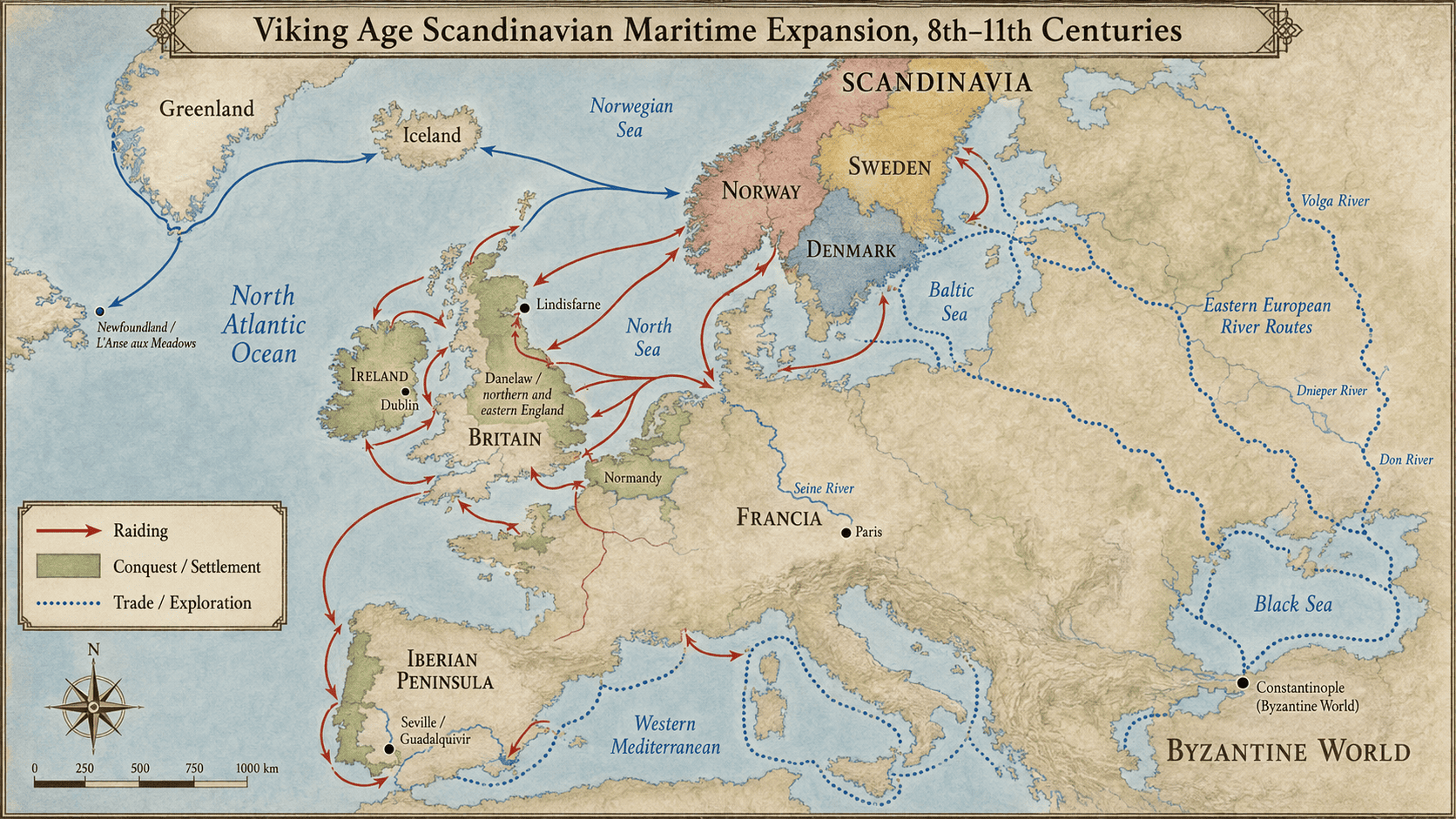
Viking raiding spread far beyond the Scandinavian homelands because ships connected the North Sea and Atlantic coasts with river systems that reached deep into European territory. The geography of Viking activity also changed over time. Some places experienced brief raids, others became bases for repeated attacks, and several eventually developed into permanent Scandinavian settlements or territories ruled by Norse elites. By the ninth and tenth centuries, Viking expansion could no longer be described simply as coastal piracy.
Britain and Ireland
After early attacks such as Lindisfarne, Scandinavian raiding spread across the British Isles, repeatedly targeting monasteries, coastal settlements, and increasingly important political and commercial centers.
Ireland began experiencing Scandinavian raids near the end of the eighth century. Initially, raiders generally appeared seasonally and withdrew, but that pattern changed during the ninth century. Scandinavian forces began establishing fortified maritime bases known as longphorts, which allowed them to remain in Ireland and launch further operations without returning to Scandinavia after every campaigning season.
Dublin developed from one of these Viking bases. A Norse settlement was established there in the ninth century, and the site became far more than a raiding camp. Dublin grew into an important commercial center with connections extending through the Irish Sea and wider Viking trading networks. Other Scandinavian settlements developed around places such as Waterford, Wexford, Cork, and Limerick.
In England, the scale of Scandinavian activity changed even more dramatically. In 865, the force traditionally called the Great Heathen Army began sustained campaigns against the Anglo-Saxon kingdoms. Here the significance is territorial: Scandinavian armies defeated rulers, occupied land, and established political control rather than simply carrying captured wealth back to their ships.
By the late ninth century, much of northern and eastern England had come under Scandinavian influence. The region later known as the Danelaw was characterized by Scandinavian settlement and legal and political traditions alongside the existing Anglo-Saxon population.
Britain therefore demonstrates the progression from raiding to military conquest and settlement. People who first appeared as maritime attackers could, within generations, become farmers, merchants, town residents, landholders, and political rulers.
Francia and the Siege of Paris
The Frankish kingdoms were also repeatedly targeted, especially because navigable rivers provided routes from the coast into wealthy inland regions.
The Seine became one of the most important of these corridors. Scandinavian fleets could enter from the English Channel and move upstream toward settlements that would otherwise have been far removed from maritime attack. Rouen was attacked in the ninth century, and Paris became an especially prominent target.
In 845, a large Scandinavian force traveled up the Seine and attacked Paris. Contemporary Frankish evidence identifies the leader as a Norse chieftain commonly rendered as Reginherus. Later tradition has associated this figure with the legendary Ragnar Lothbrok, but the identification is not historically certain and should not be treated as established fact.
King Charles the Bald ultimately paid the attackers to withdraw. Such payments demonstrated that a sufficiently powerful Viking force could extract wealth without permanently occupying the city.
Paris faced another major Scandinavian assault in 885–886, this time involving a prolonged siege rather than the pattern of a quick coastal raid. By this stage, Viking activity in Francia had become intertwined with Frankish political struggles, military service, tribute, and settlement.
The long-term transformation is particularly visible in Normandy. In 911, the Frankish king Charles the Simple reached an agreement with the Scandinavian leader Rollo, granting him territory around the lower Seine in return for loyalty and defense against further Viking attacks. The lands controlled by Rollo and his successors developed into Normandy.
The result illustrates a recurring pattern of the Viking Age: groups that originally appeared as raiders could become recognized rulers and defenders of territories they had once threatened.
Iberia and the Mediterranean
Scandinavian raiders also operated far south of the regions normally associated with Viking activity.
In 844, Viking ships attacked the Iberian Peninsula, striking areas along both Christian and Muslim-controlled coasts. After attacks around the Atlantic coast, a force entered the Guadalquivir River and reached Seville, then part of the Umayyad Emirate of Córdoba.
The attack demonstrated that Scandinavian fleets could exploit major rivers far outside northern Europe. The forces of Emir Abd al-Rahman II eventually defeated the raiders, and the experience contributed to stronger maritime defenses against future attacks.
Scandinavian expeditions returned to Iberian waters later in the ninth century. Some continued through the Strait of Gibraltar and into the Mediterranean, attacking or threatening settlements along its western coasts.
These expeditions show the geographic range Viking seafarers could achieve, but they should not be interpreted as evidence that Scandinavians established lasting political control everywhere they raided. Iberia and much of the Mediterranean remained primarily zones of expedition, plunder, and temporary operations rather than large-scale Scandinavian settlement.
Raiding Was Only Part of Viking Expansion
The geographic reach of Scandinavian seafarers extended much farther than the areas they attacked as raiders. Trade, migration, mercenary service, colonization, and exploration created additional networks that should not be classified automatically as piracy.
To the east, Scandinavians traveled through the river systems of what are now Russia, Ukraine, and neighboring regions, connecting the Baltic with the Black Sea and Caspian worlds. These routes supported trade in silver, furs, enslaved people, and luxury goods. Scandinavian warriors also entered military service abroad, most famously in connection with the Byzantine world and the later Varangian Guard.
In the North Atlantic, the pattern was primarily one of migration and settlement rather than raiding. Norse settlers reached Iceland during the ninth century, establishing farming communities and political institutions there.
From Iceland, further voyages led to Greenland, where Norse settlements were established in the late tenth century, traditionally associated with Erik the Red. These communities were attempts at colonization, not pirate bases.
Around the turn of the eleventh century, Norse voyagers also reached North America. Archaeological evidence from L’Anse aux Meadows in Newfoundland confirms a Norse presence centuries before Columbus. The voyages associated in later Norse tradition with Leif Erikson belong primarily to exploration and attempted settlement rather than Viking piracy.
The same Scandinavian maritime culture therefore produced very different activities in different regions: raids in some places, conquest in others, permanent settlement elsewhere, and long-distance commerce and exploration across an enormous geographic area.
Why Viking Raiding Declined and the Viking Age Ended
Viking raiding declined gradually rather than ending at a single moment. By the eleventh century, the political and military conditions that had favored earlier hit-and-run expeditions had changed. European kingdoms developed stronger defenses and more effective responses to maritime attacks, while Denmark, Norway, and Sweden themselves became more centralized Christian kingdoms. Scandinavian warfare continued, but increasingly under kings and organized states rather than independent raiding bands operating in the pattern associated with the earlier Viking Age.
Stronger Defenses and Organized Resistance
Early Viking raids benefited from attacking communities that had limited preparation for sudden assaults from the sea. Over time, repeated attacks forced European rulers to adapt.
In West Francia, rulers strengthened the defenses of towns, monasteries, river crossings, and coastal areas, making it harder for Scandinavian forces to penetrate inland without facing organized resistance. Fortified bridges could obstruct rivers that had once served as convenient invasion routes.
England developed its own defensive response. Under Alfred the Great and his successors, networks of fortified settlements known as burhs provided protected centers where populations and military forces could gather. Better-organized armies and fortified positions reduced the effectiveness of attacks that depended on reaching vulnerable communities before defenders could respond.
Naval resistance also improved. Rulers increasingly understood that Scandinavian forces had to be confronted not only after they landed but also along the waterways that made their mobility possible.
These measures did not eliminate Viking attacks. Large Scandinavian armies remained capable of serious campaigns during the tenth and early eleventh centuries. But raiders increasingly faced societies that had spent generations learning how to defend against them.
Christianity and Stronger Scandinavian Kingdoms
During the tenth and eleventh centuries, Denmark, Norway, and Sweden gradually developed stronger monarchies. Kings expanded their authority, competed to control territory and military resources, and increasingly brought local elites under royal power.
Christianization accompanied this political transformation. Denmark's Harald Bluetooth publicly associated himself with Christianity in the tenth century, while Norway underwent major conversion efforts around the turn of the millennium. Sweden's conversion developed more gradually.
Christianity did not simply cause Viking raiding to stop. Christian Scandinavian rulers could still wage aggressive wars, demand tribute, and conquer foreign territory. The difference was increasingly one of political organization and legitimacy.
As Scandinavian rulers joined the Christian political world of Europe, warfare became more closely connected with royal ambitions, dynastic claims, taxation, and state-building. The conquest of England by Sweyn Forkbeard and the later North Sea empire of his son Cnut illustrate how far this transformation had progressed: Scandinavian expansion could now operate through kings commanding organized kingdoms rather than through the smaller raiding enterprises characteristic of earlier centuries.
Did Viking Raiding End in 1066?
The year 1066 is commonly used as the conventional endpoint of the Viking Age, largely because of the failed invasion of England led by Norwegian king Harald Hardrada.
Hardrada landed in northern England with a substantial force and defeated an English army at Fulford. King Harold Godwinson then marched north and defeated the Norwegians at the Battle of Stamford Bridge on September 25, 1066. Hardrada was killed in the battle.
Stamford Bridge is symbolically useful because Hardrada represents one of the last major Scandinavian kings to attempt conquest of England in the tradition of earlier Viking expansion. Yet calling it the exact moment when Viking raiding ended would be misleading.
Scandinavian forces continued to threaten and attack parts of Britain after 1066, and Danish kings still considered claims to England. Nor did Scandinavian maritime warfare disappear.
What changed was the broader system around it. By the late eleventh century, Scandinavia had become increasingly integrated into Christian European politics, Scandinavian kingdoms were more centralized, and many of the territories once vulnerable to Viking raids possessed stronger institutions and defenses. 1066 therefore marks a historical transition more clearly than it marks the literal disappearance of Viking raiders.