
Pirate Sloop: Design, Speed, Weapons, and Golden Age Use
A pirate sloop was generally a small, fast, shallow-draft sailing vessel adapted for piracy rather than a special type of ship built exclusively for pirates. Its combination of speed, maneuverability, shallow-water access, efficient windward sailing, and a manageable rig made it especially useful for raiding merchant traffic in the Caribbean and along the North American coast. Although relatively compact, a sloop could also carry far more men than were strictly needed to sail it, giving pirates a numerical advantage during boarding actions.
This article explains how pirate sloops were designed and rigged, how they were armed and used in raids, and how historical vessels such as Stede Bonnet’s Revenge, Blackbeard’s Adventure, and Calico Jack Rackham’s William operated in practice.
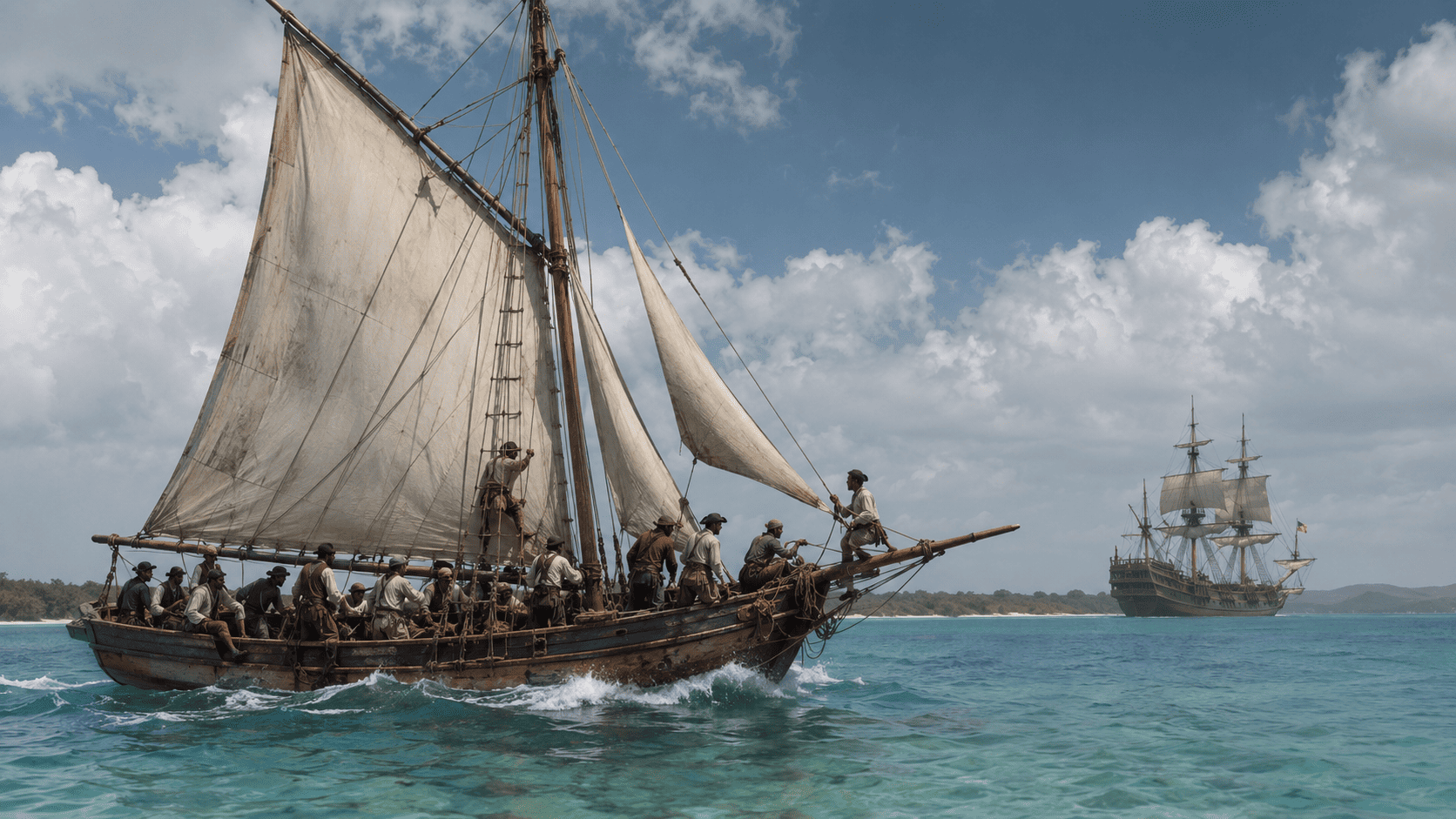
What Was a Pirate Sloop?
During the Golden Age of Piracy, sloops were already established working vessels in the Caribbean and western Atlantic. They carried cargo and passengers, connected islands and coastal ports, and served merchants, private owners, and maritime authorities. Pirates entered an existing world of sloop construction and use rather than creating the vessel type themselves.
A Pirate Sloop Was Usually a Repurposed Vessel
Pirates generally depended on vessels that already existed. A suitable merchant or private sloop might be captured and incorporated into a pirate company, while an inferior vessel could be abandoned when a better prize became available. Pirates could alter rigging, redistribute space, add weapons, or make other changes according to the crew’s needs.
Stede Bonnet’s Revenge provides an unusual counterexample. Rather than beginning his career by seizing a ship, the wealthy Barbados landowner purchased and outfitted his own sloop in 1717. The vessel’s armament and unusually large crew are discussed in detail below, but the important distinction here is how Bonnet acquired it: buying a vessel specifically for his venture was not the normal pirate method.
Jamaica and Bermuda Sloops in the Caribbean
The Caribbean produced regional sloop designs suited to its trading environment. Jamaica and Bermuda became closely associated with relatively light sailing vessels used to move people and goods between islands, coastal settlements, and larger ports.
Bermuda developed an especially strong boatbuilding tradition based on local Bermuda cedar. Bermuda sloops were single-masted vessels valued for their light construction, speed, resistance to rot and shipworm, and ability to operate while drawing relatively little water. Those qualities made them useful to merchants and privateers as well as pirates and naval forces.
Jamaican sloops likewise developed within a Caribbean environment shaped by coastal trade, privateering, and raiding. These regional traditions help explain why historical sloops could differ from one another rather than conforming to a single standardized design.
Pirate Sloop vs. Sloop-of-War
A sloop and a sloop-of-war should not be treated as interchangeable terms.
In the sailing-vessel sense relevant to Caribbean piracy, a sloop was generally a small, single-masted vessel. The term described characteristics of the craft itself and, depending on period and region, could encompass variations in rig.
A sloop-of-war, by contrast, was primarily a naval classification. In eighteenth-century British usage, it referred to an unrated warship below the major rated classes. Such vessels could carry roughly 10 to 18 guns and could have two or even three masts.
This explains the apparent contradiction in historical descriptions: a typical sailing sloop could be single-masted while a vessel officially classified by a navy as a sloop-of-war might not be. The word sloop was being used in two different maritime contexts.
Why Pirates Preferred Sloops
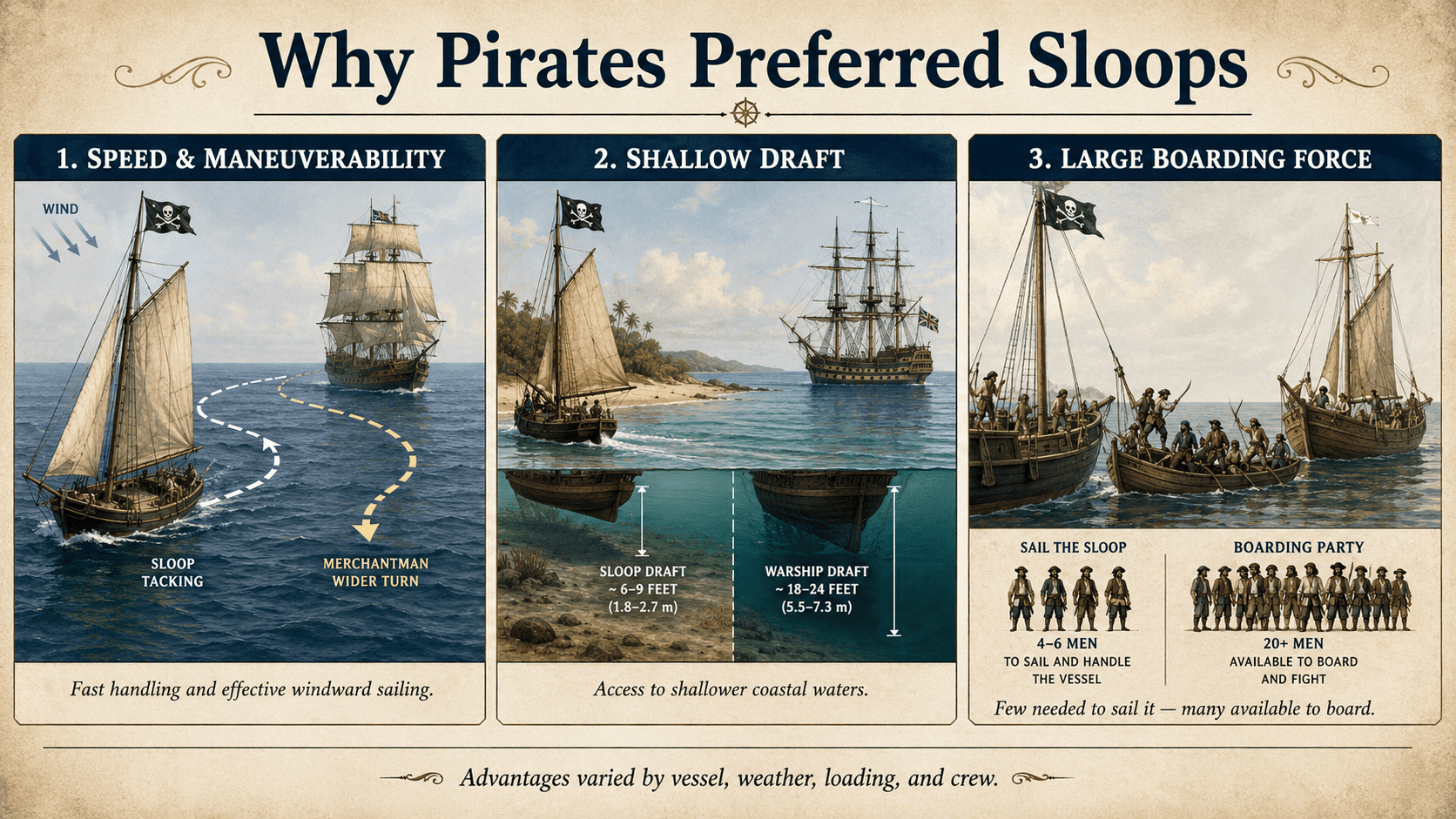
Piracy rewarded crews that could choose favorable targets and avoid opponents with superior firepower. Sloops fit that requirement particularly well because their sailing characteristics gave pirates considerable freedom to pursue, reposition, operate near coasts, or withdraw when an encounter became too dangerous.
Speed, Windward Sailing, and Maneuverability
A sloop’s fore-and-aft rig was particularly useful because its sails were oriented more nearly along the vessel’s centerline rather than primarily across it, as on a square-rigged ship. This arrangement generally allowed a well-handled sloop to sail closer to the wind and make more effective progress to windward.
That mattered operationally. Sailing ships could not simply travel directly wherever their captains wanted; their routes depended heavily on wind direction. When the desired destination lay toward the wind, a vessel had to tack, sailing a zigzag course from one side of the wind to the other. A maneuverable fore-and-aft-rigged sloop could perform these changes of direction efficiently.
Pirates could use that handling advantage in two opposite situations. When a merchant vessel appeared vulnerable, a sloop could maneuver to reduce the distance and improve its position for interception. If the target changed course or wind conditions shifted, the pirates could adjust their approach accordingly.
Just as importantly, pirates did not have to accept every fight. A naval vessel, heavily armed merchantman, or unexpected escort might make an intended prize too dangerous. The same handling qualities that helped a sloop pursue shipping could help it disengage from a stronger opponent.
There was no universal top speed for a pirate sloop. Performance depended on hull design, rig, sail condition, loading, weather, sea state, and the skill of the crew. Describing sloops as operationally fast and maneuverable is therefore more accurate than assigning every vessel a single maximum speed.
Shallow Draft and Coastal Escape
The sloop’s relatively shallow draft—the depth of hull extending below the waterline—gave pirates access to waters that could be hazardous or inaccessible to larger ships.
This was particularly useful in the Caribbean and along the Atlantic coast of North America, where sailors encountered islands, reefs, shoals, sandbars, narrow channels, river mouths, and coastal inlets. A vessel drawing less water could operate closer to shore and cross some shallow areas where a larger merchantman or warship risked grounding.
For pirates, that created both offensive and defensive possibilities. Coastal shipping could be approached in waters where larger naval vessels were less comfortable maneuvering, while familiar shoals or channels could provide routes toward temporary refuges and anchorages.
The advantage became especially important during a pursuit. A deeper-draft warship might be faster or more powerful under favorable conditions, but its captain had to consider the risk of running onto a reef or sandbar. A pirate sloop that could safely continue into shallower water might force the pursuing vessel to slow, change course, send a smaller craft ahead, or abandon the chase.
This did not make a sloop impossible to catch. Naval authorities could use smaller craft—including sloops themselves—to pursue pirates in waters unsuitable for larger warships. Shallow-water capability was an advantage, not a guarantee of escape.
Small Sailing Crew, Large Boarding Force
The relatively manageable rig of a sloop created another useful distinction: the number of sailors needed to operate the vessel did not necessarily determine the number of men it could carry.
A merchant sloop might be worked economically by a comparatively small crew because its owner wanted to minimize labor costs. A pirate captain had different priorities. Extra men represented mouths to feed and reduced available space, but they could provide an important advantage when another vessel had to be seized at close range.
As a result, a pirate sloop could carry far more men than were strictly necessary to sail it. Once a target was brought alongside, those additional crewmen became a boarding force capable of overwhelming the smaller working crew commonly found aboard merchant vessels.
A small vessel therefore did not necessarily mean a small pirate crew. The same sloop that required relatively few sailors to handle its rig could be deliberately crowded with additional men intended primarily for raids and boarding actions.
Pirate Sloop Design, Rigging, and Armament
There was no universal blueprint for a pirate sloop. Vessels differed according to where they were built, their original purpose, local construction practices, and the modifications made during their working lives. A Caribbean trading sloop, a Bermuda-built vessel, and a captured craft refitted by pirates could therefore differ considerably in dimensions, sail plan, armament, and internal arrangement.
Hull, Size, and Draft
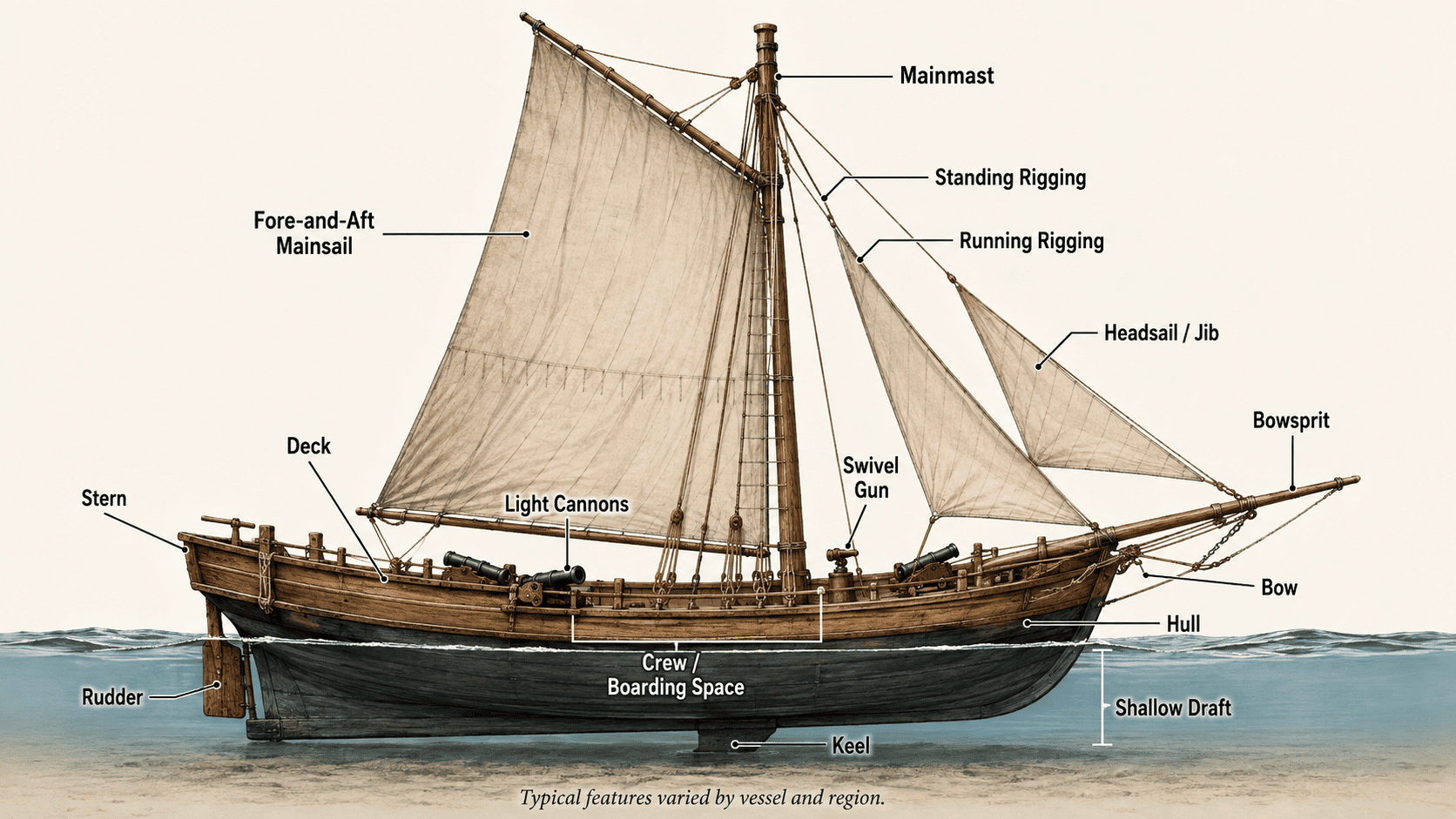
Pirate sloops were wooden vessels with hulls generally smaller than the large merchantmen and warships that dominate popular images of the Age of Sail. Their proportions varied by region and purpose, making it misleading to present one length, tonnage, or set of dimensions as the standard specification for a pirate sloop.
Their hulls generally drew relatively little water compared with larger ocean-going vessels, although the exact draft depended on the design and how heavily the ship was loaded.
Loading could significantly change a vessel’s behavior. Guns, ammunition, provisions, captured goods, and an unusually large crew all increased displacement and consumed limited space. Measurements recorded for one historical sloop should therefore be understood as characteristics of that vessel, not specifications for the entire type.
Mast, Mainsail, Headsails, and Bowsprit
The characteristic Caribbean sloop was generally built around a single mainmast carrying a fore-and-aft mainsail. Ahead of the mast, one or more headsails could be set on stays running toward the bow, including sails described as jibs or staysails depending on the particular arrangement.
A conspicuous feature of many Bermuda and Caribbean sloops was the bowsprit, a spar projecting forward from the bow. A long bowsprit provided additional space for setting headsails and effectively extended the sail plan beyond the physical length of the hull.
Historical rigs were not perfectly uniform. Sails and spars could be changed, replaced, or adapted, and terminology varied by period and region. A Golden Age sloop should therefore not be defined simply by applying the configuration of a modern recreational sloop-rigged yacht.
Cannons, Swivel Guns, and Small Arms
A pirate sloop could be armed, but there was no fixed number or caliber of guns associated with the type. Some carried only a modest battery, while more heavily fitted vessels could mount considerably greater firepower.
Light cannons were generally more practical than the very heavy guns carried by major naval vessels. Weight mattered on a small hull: every large gun required space, ammunition, mounting hardware, and crew while also affecting stability and carrying capacity.
Pirates could supplement deck guns with swivel guns, smaller weapons mounted so they could be turned rapidly toward different targets. Personal weapons such as pistols, muskets, cutlasses, and other edged weapons became important as vessels closed to boarding distance.
This combination of weapons provided intimidation and close-range fighting power without requiring the sloop to function like a heavily armed naval ship. Pirates generally had more to gain from taking a usable vessel and its cargo than from destroying both.
Crew and Cargo Space
The sloop’s compact dimensions imposed strict limits on available space. A pirate crew had to accommodate men, food, drinking water, powder, shot, weapons, spare equipment, and captured property inside a hull originally designed for more conventional maritime work.
Sleeping and working areas could become crowded, particularly when pirates carried more men than a merchant operator would normally employ on the same vessel. Provisions added another constraint: water and preserved food had to support the crew, while ammunition and replacement gear needed to remain accessible.
A successful capture created additional pressure on storage. Valuable cargo had to be transferred, sold, divided, or carried until another opportunity arose. The crew therefore had to balance men, weapons, provisions, and loot against the limited carrying capacity of a relatively small hull.
How Pirates Used Sloops in Raids
A successful raid depended less on indiscriminate fighting than on controlling the encounter. Pirates had to identify a vulnerable target, approach without giving it too much time to escape or prepare, compel surrender, and withdraw if circumstances turned against them.
Chasing and Approaching Merchant Ships
A lookout positioned high enough to scan the horizon could provide the first warning of another vessel. Once a sail was sighted, the pirate captain had to decide whether the potential target was worth pursuing. Size, apparent armament, course, nationality, and the possibility of a naval escort all influenced that decision.
Merchant vessels were particularly attractive because they could carry valuable cargo while operating with crews much smaller than those aboard pirate vessels. Once a target was selected, the pirates could work to close the distance, alter their approach as wind conditions changed, or abandon the chase if the situation no longer favored them.
Pirates also had reasons to conceal their identity for as long as possible. Historical accounts describe pirate vessels using false colors, displaying the flag of a friendly or neutral nation while approaching a target. A pirate flag or other unmistakable hostile signal might be shown only after the vessels were close enough that escape became more difficult.
False colors were a tactic rather than a universal pirate procedure. Some crews relied on deception, while others pursued openly when they already held a clear advantage. In either case, the objective was to reduce the target’s opportunity to flee, prepare defenses, or seek assistance.
Intimidation, Cannon Fire, and Boarding
The ideal outcome for pirates was often surrender without a destructive battle. A merchant ship represented more than an enemy hull: its cargo, provisions, weapons, sails, rigging, anchors, tools, and sometimes the vessel itself could all have value.
Once close enough, pirates could use visible weapons or a warning shot to demonstrate their willingness to fight. If the target continued resisting, cannon fire could be directed at sails, rigging, masts, or steering equipment to interfere with its ability to escape rather than simply battering the hull.
At shorter distances, swivel guns and small arms could suppress defenders during the final approach. Boarding then brought the pirate crew’s numerical strength into play. A heavily manned sloop might place more attackers on the deck than the merchant crew could effectively resist.
After gaining control, pirates could search the vessel, question its crew, transfer valuable cargo, replenish provisions, take useful equipment, or keep the captured ship itself. Combat was therefore usually a means of obtaining possession rather than an objective in itself.
Escaping Through Shoals, Reefs, and Inlets
A raid could quickly become a retreat if a naval patrol, armed merchant vessel, or unexpected reinforcement appeared. In that situation, pirates familiar with local waters could steer toward shoal areas, reef passages, narrow channels, river mouths, or coastal inlets that posed greater risks to a larger pursuer.
Local knowledge made the tactic more effective. Crews operating repeatedly around the same islands or coastlines could learn which channels remained navigable and where a deeper vessel was likely to risk grounding.
Such refuges were not completely safe. Authorities could send smaller craft into the same waters, block exits, or continue the pursuit ashore. The advantage came from forcing a larger warship into a navigation problem for which its heavier guns offered no simple solution.
Famous Pirate Sloops
Historical examples show how differently pirates could acquire and employ sloops. Some were deliberately purchased and armed, others were captured and added to a flotilla, and others served as compact raiding vessels for relatively small companies.
Stede Bonnet’s Revenge / Royal James
Stede Bonnet’s Revenge is one of the clearest examples of a pirate sloop because, unusually, it was purchased and outfitted rather than captured. Bonnet was a wealthy Barbados landowner with little practical seafaring experience when he entered piracy in 1717. Instead of acquiring his first vessel as a prize, he financed the sloop himself and hired men to sail it.
Early accounts describe the Revenge as carrying about 10 guns and roughly 70 men. The size of that company illustrates an important feature of pirate use: a relatively small vessel could carry far more men than were needed merely to handle its sails, providing a substantial fighting force when a prize had to be boarded.
The Revenge later became closely associated with Blackbeard during the period when Bonnet sailed with him. After Bonnet resumed independent command, the vessel was renamed Royal James. In 1718, it operated around the Cape Fear River in North Carolina, where Bonnet and his crew careened and repaired the ship before South Carolina forces attacked them.
The vessel was ultimately captured during Bonnet’s defeat at Cape Fear. Its history provides an important exception to the usual pattern of pirates obtaining vessels through seizure or replacement with captured prizes.
Blackbeard’s Adventure
Blackbeard’s Adventure demonstrates a different role for the sloop. In 1718, Blackbeard captured a Jamaican sloop named Adventure and incorporated it into his pirate force.
At the time, he also commanded the much larger and more heavily armed Queen Anne’s Revenge. The coexistence of the two vessels shows that a pirate captain did not necessarily choose between a large flagship and a small sloop. Different vessels could fill different roles within the same operation.
The larger Queen Anne’s Revenge offered greater firepower, carrying capacity, and intimidation, while a smaller craft such as Adventure was easier to handle in confined waters. A sloop could also move part of a crew, scout, pursue smaller prizes, or remain useful when a larger vessel became impractical.
That flexibility became especially relevant after Queen Anne’s Revenge grounded near Beaufort, North Carolina, in 1718. Blackbeard continued operating with smaller vessels, including Adventure, rather than depending on a single large flagship.
Calico Jack Rackham’s William
John “Calico Jack” Rackham’s William represents the kind of small sloop suited to short-range Caribbean raiding.
In August 1720, Rackham and a small group seized the William at Nassau in the Bahamas and sailed away with it. Anne Bonny and Mary Read were among the crew members during the subsequent cruise.
The William did not support operations on the scale associated with large pirate flagships. Rackham’s company instead used the sloop to move through Caribbean waters and raid smaller vessels with a relatively compact force.
Its career ended only a few months later. In late 1720, a vessel commanded by Jonathan Barnet encountered Rackham’s sloop near Jamaica and captured the crew. Rackham, Bonny, Read, and the others were subsequently taken ashore for trial.
The William illustrates a reality of Golden Age piracy easily obscured by popular images of enormous multi-deck pirate ships: many pirate operations could be carried out from a small, practical sailing vessel whose effectiveness depended on mobility and boarding strength rather than overwhelming naval firepower.