
Pirate Code: Real Pirate Rules and Articles of Agreement
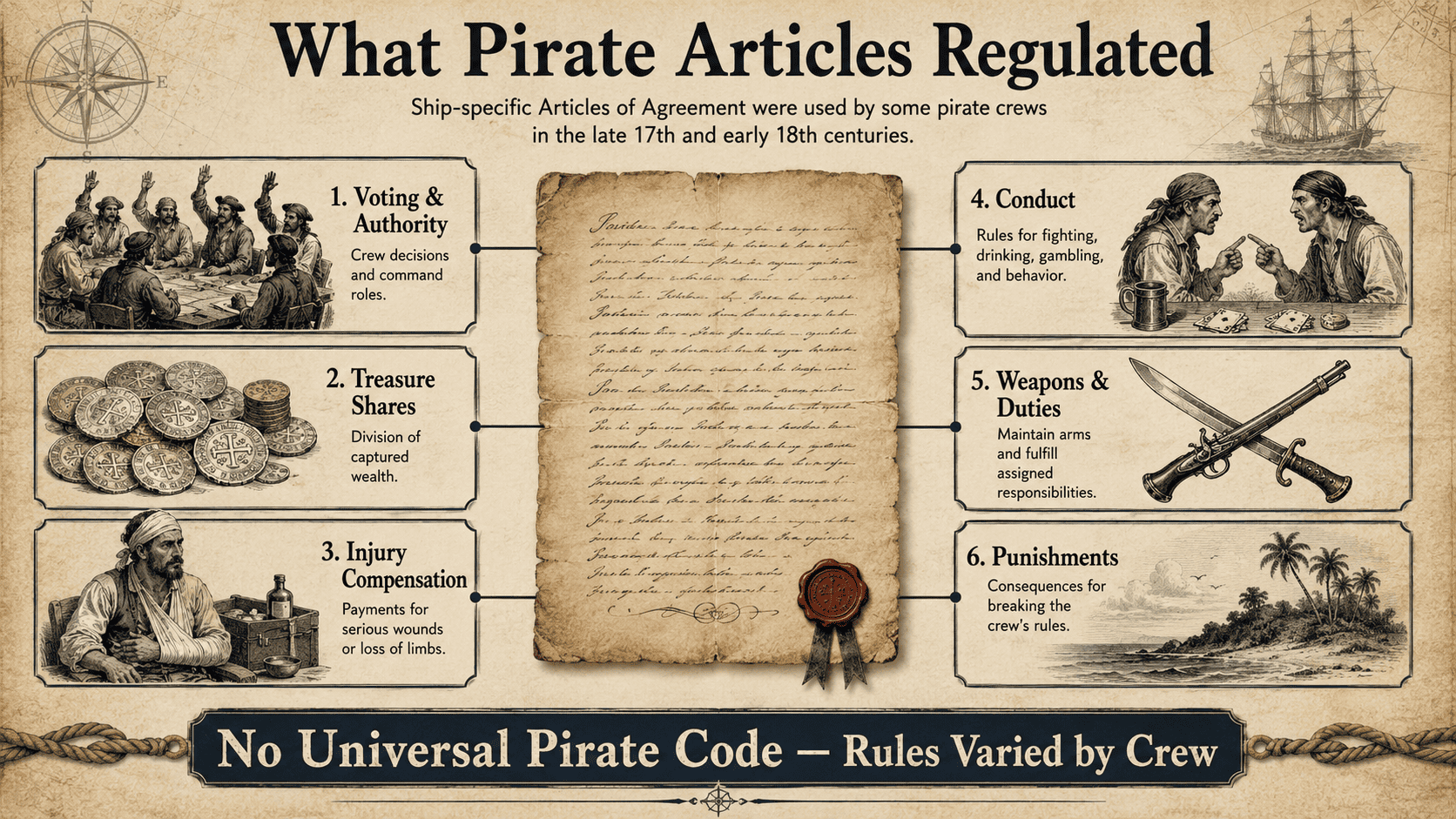
The pirate code was real, but it was not a single universal rulebook followed by every pirate. Historically, the term refers to the ship-specific Articles of Agreement adopted by many pirate and buccaneer crews, especially during the seventeenth and early eighteenth centuries. These agreements regulated practical matters such as treasure shares, voting and command authority, discipline, acceptable behavior, compensation for serious injuries, and punishments for breaking the rules.
Because each crew could establish its own terms, surviving pirate codes differ in both wording and detail. Some of the best-known examples are associated with Bartholomew Roberts, John Phillips, Edward Low, George Lowther, and John Gow. Examining these surviving articles shows how real pirate crews organized life aboard ship—and where later pirate legends differ from the historical record.
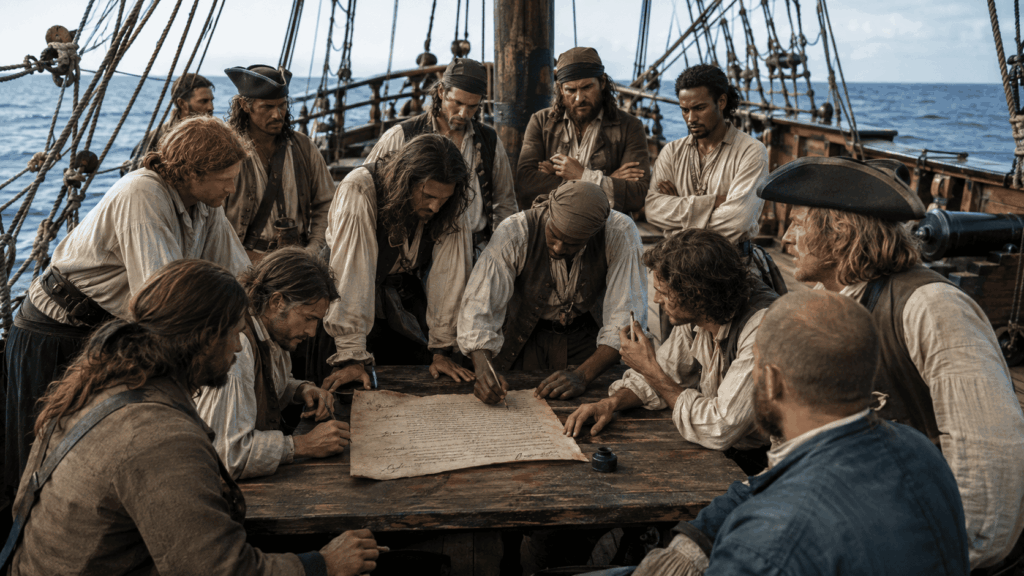
History and Origins of the Pirate Code
The agreements associated with pirate crews developed from older maritime contracting practices and became particularly visible among Caribbean buccaneers during the seventeenth century. Rather than creating an entirely new system, pirates adapted existing ways of setting terms for service, profit sharing, discipline, and collective ventures at sea.
There Was No Single Universal Pirate Code
Each pirate company could negotiate its own terms, which is why surviving sets of articles differ in wording, punishments, compensation, and the distribution of shares. A provision accepted aboard one ship was not automatically binding on another, even when the crews operated during the same period or in the same region.
Certain themes nevertheless appeared repeatedly. Crews commonly agreed in advance on matters such as discipline, shares of captured wealth, duties aboard ship, compensation for serious injuries, and penalties for violating the agreement. These recurring features allow historians to compare different sets of articles without treating them as parts of a standardized legal code issued by a central authority.
Later books and movies helped popularize the idea of a single “Pirate Code,” but the historical record instead preserves a collection of related agreements created for particular crews and voyages.
From Maritime Articles to Buccaneer Agreements
Pirate articles developed from older maritime practices rather than appearing suddenly with Golden Age piracy. Merchant sailors, privateers, and other seafaring ventures already used written agreements to establish conditions of service, responsibilities, and the distribution of earnings or prize money.
Seventeenth-century Caribbean buccaneers adapted similar contractual practices to their own expeditions. Alexandre Exquemelin, whose account of the buccaneers was first published in 1678, described crews making written agreements before a voyage to determine how proceeds would be divided and how men injured in action would be compensated. These arrangements provided an important precedent for the more detailed articles associated with eighteenth-century pirate crews.
Privateering also supplied a useful model. Privateers operated under government authorization, but their crews could enter formal articles governing service and prize shares. Pirates adopted comparable contractual mechanisms while operating outside the law.
Chasse-Partie, Custom of the Coast, and Jamaica Discipline
Historical sources and later writers use several expressions for agreements associated with buccaneers and pirates. The French term chasse-partie referred to an agreement made by Caribbean freebooters before an expedition, particularly concerning shares and compensation.
Terms such as Custom of the Coast and Jamaica Discipline have also been used to describe practices associated with Caribbean buccaneers and later pirates. They should not be treated as alternative titles for one standardized document. Modern scholarship has questioned the idea that a single, coherent “Jamaica Discipline” governed generations of privateers and pirates; surviving evidence instead points to considerable variation among crews and periods.
How Pirates Adopted and Signed the Articles
Articles were generally established when a pirate company was being organized or reorganized, often before beginning a cruise. Members agreed to the terms and could sign the document or make a mark if they could not write their names. Oaths reinforced the agreement. One well-known account states that John Phillips’ crew swore to their articles on a hatchet because no Bible was available.
Signing also had consequences beyond shipboard discipline. A name on pirate articles could help establish that a sailor had joined a pirate company voluntarily, making the document potentially damaging evidence if the crew was captured.
Not every signature, however, necessarily represented free consent. Some defendants later claimed that pirates had forced them to join or sign, and contemporary accounts include cases in which unwilling men were threatened into association. This distinction between voluntary membership and coercion could become crucial when accused pirates attempted to defend themselves in court.
How Pirate Codes Governed Life Aboard Ship
Pirate crews used their Articles of Agreement to define authority, distribute captured wealth, compensate injuries, regulate conduct, and establish penalties before disputes arose. These rules were practical tools for managing men who shared dangerous work and valuable prizes but operated without the legal and institutional structure of a naval or merchant vessel. The details varied from crew to crew, but surviving accounts show that pirate articles often combined elements of a contract, disciplinary code, and profit-sharing agreement.
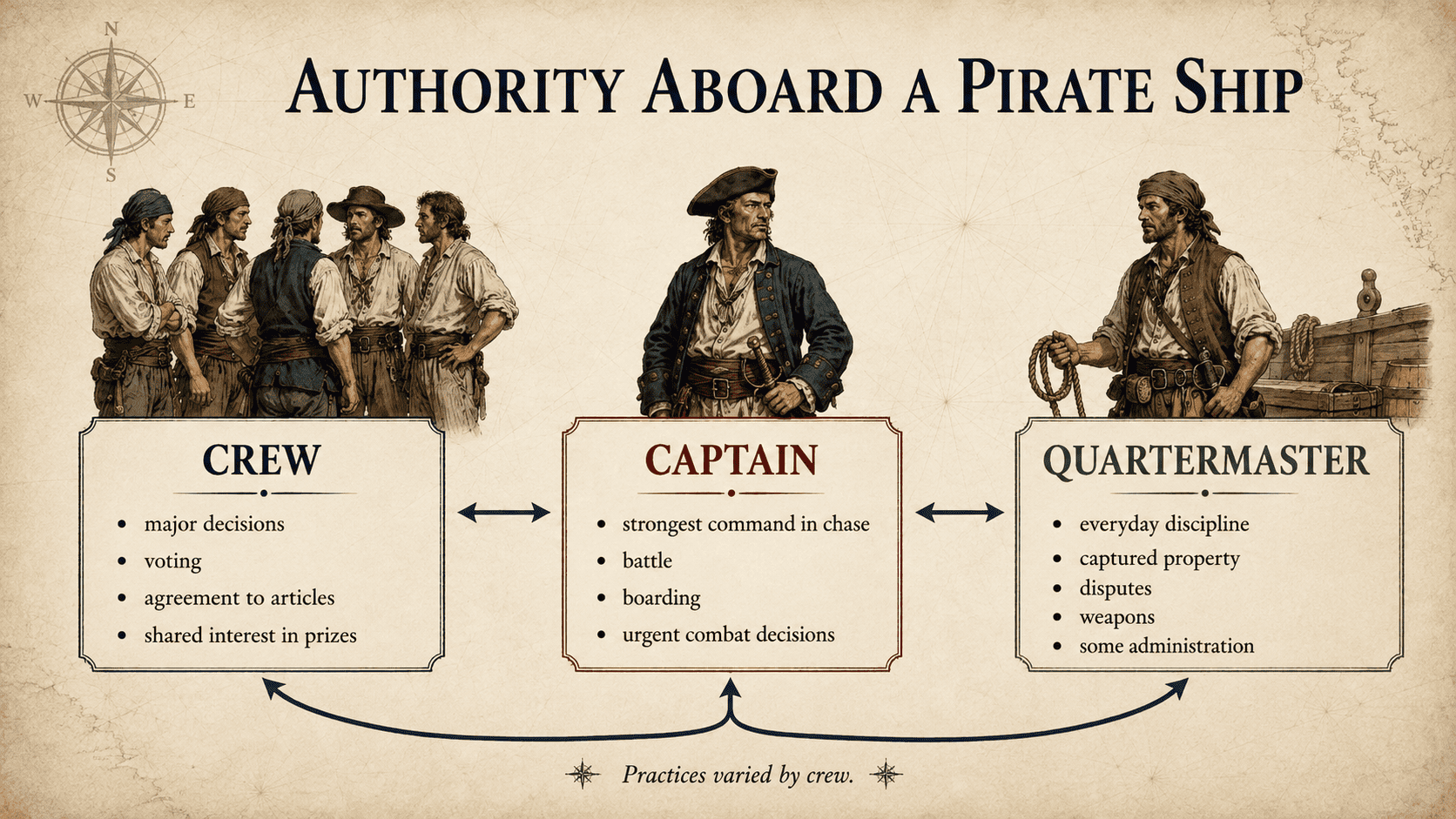
Voting, Captains, and Quartermasters
On some well-documented pirate ships, major decisions were subject to a crew vote. Bartholomew Roberts’ articles, for example, granted each man a vote in matters of importance. Captains could also be chosen by the company rather than appointed by an outside owner or government authority. Contemporary accounts describe pirates electing men considered experienced, capable, and courageous enough to command.
This did not make pirate ships democracies in the modern political sense. Voting served the immediate interests of a criminal maritime enterprise, and authority was divided according to circumstance.
A captain's strongest authority generally came during pursuit, combat, and other situations requiring rapid military decisions. Outside battle, his power could be substantially more limited. A captain who repeatedly failed, endangered the crew, or lost their confidence could face removal. A 1724 account of Roberts’ crew describes the captaincy as obtained through majority support and even reports that opposition formed when Roberts became increasingly unpopular with influential members of his company.
The quartermaster could provide an important counterweight. In the same account, he was chosen by the men and exercised authority over everyday discipline outside battle. He could supervise captured property, settle or oversee disputes, inspect weapons, and punish lesser offenses. Roberts’ articles also describe the quartermaster accompanying crewmen ashore when personal quarrels could not be reconciled aboard ship.
Authority, therefore, was not necessarily concentrated in one person. Captain, quartermaster, officers, and crew could exercise different forms of power depending on the situation.
Dividing Plunder and Treasure Shares
Piracy was a profit-seeking enterprise, so the distribution of captured wealth was one of the most important matters to settle in advance. Articles commonly defined shares rather than leaving division of a prize to the captain's discretion.
An ordinary crewman might receive a standard share, while the captain, quartermaster, navigator, carpenter, boatswain, gunner, or other skilled officers could receive larger portions. The exact ratios were not universal. Each company could establish its own terms, and surviving pirate articles show different arrangements.
This system gave crew members a direct financial stake in successful captures. It also reduced opportunities for officers to appropriate an undefined portion of the proceeds. Rules against secretly taking money, jewels, or other valuables served the same purpose: concealed plunder was not simply theft from an individual but an attempt to deprive the entire company of property that was supposed to enter the common division.
The practice also reflected a wider maritime tradition. Formal articles used aboard legitimate privateering vessels could specify employment conditions and assign different prize shares by rank, demonstrating that contractual division of captured property was not unique to pirates.
Compensation for Injuries
Serious injury was an occupational reality of piracy. Cannon fire, musket balls, edged weapons, boarding actions, and shipboard accidents could leave a sailor unable to continue working, with little prospect of earning a living ashore.
Some articles therefore reserved money from the common stock to compensate crew members wounded in the company's service. Payments could vary according to the severity of the injury, with the loss of a limb, eye, joint, or permanent use of part of the body receiving greater compensation than lesser wounds.
These arrangements can be understood as a rudimentary form of occupational injury compensation, although they should not be confused with modern insurance or workers' compensation systems. The practical logic was straightforward: a pirate who accepted exceptional physical risk had a contractual claim on the proceeds of the enterprise if that risk left him permanently disabled.
The system also reinforced the collective nature of the voyage. Compensation came from wealth that otherwise would have been available for distribution, meaning the crew collectively absorbed part of the financial cost of a member's injury.
Rules for Conduct, Gambling, Drinking, and Weapons
Pirate articles frequently regulated behavior that could threaten the crew's effectiveness. Gambling for money, for example, could create debts and disputes among men who had to live and fight together in confined conditions. Some codes prohibited it outright.
Fighting aboard ship could likewise endanger order. Rather than allowing personal disputes to escalate on deck, certain crews required quarrels to be settled ashore under controlled conditions.
Alcohol was regulated in some articles, although pirates were certainly not uniformly sober. Roberts’ rules required lights and candles to be extinguished at a set hour and directed men who wished to continue drinking afterward to do so on the open deck. Such restrictions combined discipline with fire safety, an essential concern aboard a wooden vessel carrying sails, rope, gunpowder, and other combustible materials.
Weapons also had to remain serviceable. Pistols, muskets, cutlasses, and other arms could be inspected and were expected to be clean and ready for action. Neglecting weapons was not a minor matter when a crew's survival depended on being prepared for a sudden chase or battle.
Other provisions addressed desertion and theft, two offenses that directly threatened the company. Desertion could reduce fighting strength or compromise the crew during combat, while stealing from the common prize undermined the agreed system of distribution.
Punishments for Breaking the Pirate Code
There was no universal schedule of pirate punishments. The penalty depended on the crew, the offense, and the particular articles in force.
Possible sanctions included forfeiting part or all of a man's share, beatings or whipping for lesser disciplinary offenses, abandonment ashore, and severe physical punishment. Contemporary descriptions assign the quartermaster authority to administer some minor punishments, while more serious violations could be governed directly by the articles or decided collectively.
Marooning was among the most distinctive penalties. An offender could be left in an isolated place with only limited supplies and weapons. In surviving accounts it appears as a punishment for offenses such as stealing from the company, concealing information, or desertion. Certain articles prescribed death for especially serious violations, including abandoning one's post in battle, although the exact penalty varied by crew.
The famous image of pirates forcing offenders to walk the plank, however, belongs largely to later pirate legend rather than the documented disciplinary systems of Golden Age crews. Historical sources support punishments such as marooning, beating, loss of shares, and execution far more clearly; the National Maritime Museum notes that walking the plank became strongly associated with pirates through later literature and film.
Real Pirate Code Examples and Surviving Articles
How Many Pirate Codes Survive?
The number of surviving pirate codes depends on what “surviving” means. An original sheet signed aboard a pirate ship is not the only way a set of articles can reach historians. Some survive as manuscripts, while others were copied into trial records, printed in contemporary newspapers, or reproduced in early eighteenth-century accounts. Bartholomew Roberts’ original signed articles, for example, were reportedly thrown overboard; the eleven provisions known today survive through the version recorded in A General History of the Pyrates in 1724.
Historian E. T. Fox’s study of pirate articles identifies nine complete or nearly complete sets surviving from the seventeenth and eighteenth centuries, associated with George Cusack, Nicholas Clough, John Taylor, Bartholomew Roberts, Thomas Anstis, George Lowther, Edward Low, John Phillips, and John Gow. Other articles, including those associated with Howell Davis and Thomas Cocklyn, survive only partially. This broader documentary definition helps explain why popular histories sometimes give much smaller numbers: they may count only particularly famous eighteenth-century examples, original documents, or readily accessible published codes rather than the wider body of texts preserved through contemporary evidence.
Bartholomew Roberts’ 11 Articles
The best-known pirate code is the set associated with Bartholomew Roberts, one of the most successful captains of the Golden Age of Piracy. According to Charles Johnson’s 1724 account, Roberts’ company created new articles after Walter Kennedy and part of the crew deserted. Johnson states that what follows was the “substance” of the agreement based on information supplied by pirates, rather than a transcription of the lost original document.
The eleven articles can be summarized as follows:
- Every crewman had a vote in important affairs and access to captured provisions and liquor, subject to rationing when supplies were scarce.
Purpose: give members a recognized voice in major decisions while allowing the company to control scarce resources. - Crewmen were to receive fair turns when boarding prizes, while stealing from the common haul or another pirate brought severe punishment.
Purpose: protect the agreed distribution of captured property and discourage private theft that could undermine trust within the crew. - Gambling for money with cards or dice was forbidden.
Purpose: reduce debts and financial quarrels among men who had to continue living and fighting together. - Lights and candles were to be extinguished at 8 p.m.; anyone continuing to drink afterward had to do so on the open deck.
Purpose: impose nighttime discipline and reduce the danger posed by open flames aboard a wooden vessel. - Weapons had to be kept clean and ready for service.
Purpose: ensure that pistols, firearms, and cutlasses were usable when a chase, boarding action, or battle began without warning. - Boys and women were prohibited from being carried with the company, and secretly bringing a woman aboard could be punished by death.
Purpose: in the crew’s own reasoning, remove potential sources of rivalry and conflict aboard ship. The rule reflects the attitudes and violent social environment of the period rather than a modern ethical standard. - Deserting the ship or abandoning one’s station during battle could bring death or marooning.
Purpose: prevent men from endangering the entire company when coordinated action was essential for survival. - Crewmen were not to fight one another aboard ship; unresolved personal disputes were to be settled ashore under the quartermaster’s supervision.
Purpose: keep violent personal quarrels from disrupting shipboard operations. - The company was not to break up until each man had accumulated a specified return; pirates permanently injured in service received compensation from the common stock.
Purpose: keep the venture together long enough to meet its financial objective while protecting men whose injuries destroyed their future earning ability. - The captain and quartermaster received two shares each; the master, boatswain, and gunner received one and a half shares, other officers one and a quarter, and ordinary crewmen a standard share.
Purpose: compensate specialized responsibilities without allowing officers to claim an unlimited portion of the prize. - Musicians were entitled to rest on the Sabbath, while rest on other days depended on permission.
Purpose: regulate labor expectations for a specialized group whose services were required regularly.
These articles are unusually useful because they cover much more than punishment. Together they address voting, supplies, property rights, work, combat readiness, compensation, profit sharing, leisure, and interpersonal conflict—the practical problems a pirate company had to manage continuously. Johnson’s text preserves all eleven provisions even though Roberts’ original signed document itself did not survive.
John Phillips’ Articles
John Phillips’ articles aboard the Revenge provide another detailed example. Johnson records nine provisions governing command, profit sharing, discipline, safety, and compensation. They began by requiring obedience to “civil command” and assigning the captain one and a half shares, with the master, carpenter, boatswain, and gunner receiving one and a quarter.
Phillips’ code was particularly explicit about discipline. Attempting to run away or concealing secrets from the company could result in marooning; theft or gambling involving property above a stated value could lead to marooning or shooting. Striking another crewman brought thirty-nine lashes, while unsafe behavior with firearms, tobacco pipes, or uncovered candles in the hold carried the same punishment.
The articles also linked work directly to financial reward: failure to maintain weapons or perform assigned duties could cost a man his share. A lost joint was valued at 400 pieces of eight, while loss of a limb brought 800. The final article imposed death for sexually assaulting a woman encountered by the crew.
Edward Low and George Lowther’s Articles
The surviving articles associated with George Lowther and Edward Low are strikingly similar. Lowther and Low sailed together before separating in 1722, and the first eight articles attributed to Low in the Boston News-Letter closely correspond to the eight Lowther articles reproduced by Johnson. This overlap suggests that pirate companies could carry rules from one crew into another and then modify them as circumstances changed.
Their articles addressed officers’ shares, fighting with weapons aboard ship, cowardice in battle, concealed gold or jewels, gaming, injury compensation, treatment of surrendering opponents, and a reward for the first man to sight a potential prize. Low’s published version adds two particularly practical provisions: drunkenness during an engagement was punishable, and firearms were not to be snapped or discharged carelessly in the hold.
The versions also illustrate why surviving pirate articles should not be treated as perfectly standardized texts. Johnson’s Lowther account awards £150 sterling for losing a limb, while the version attributed to Low in the Boston News-Letter specifies 600 pieces of eight. The broader framework remained similar, but details could change with the company, source, or revision of the agreement.
John Gow and Other Surviving Pirate Articles
John Gow’s six articles are useful precisely because they do not look identical to Roberts’ rules. Gow’s agreement emphasized obedience to the commander, equal access to provisions, secrecy about the crew’s identity and plans, restrictions on going ashore, continuous watches, and an 8 p.m. cutoff for gaming and drinking so men could report to their stations. Violations could bring death or another punishment chosen by the company. A version of these articles was recovered in connection with Gow’s capture in the Orkney Islands in 1725.
Gow’s code therefore shows why Roberts’ eleven articles should not be presented as a universal template. The other complete or nearly complete surviving sets identified by Fox—including those associated with George Cusack, Nicholas Clough, John Taylor, and Thomas Anstis—further demonstrate that pirate companies adapted their agreements to different crews and circumstances. Partial evidence from other pirates and earlier buccaneers expands the record still further, leaving historians with a collection of related contracts rather than a single historical “Pirate Code.”